The Woman Who Kept Coming Back:
Ann Lefever, Westminster Vagrant

Document Spotlight  ·  Poor Law Records  ·  Westminster  ·  March 2026
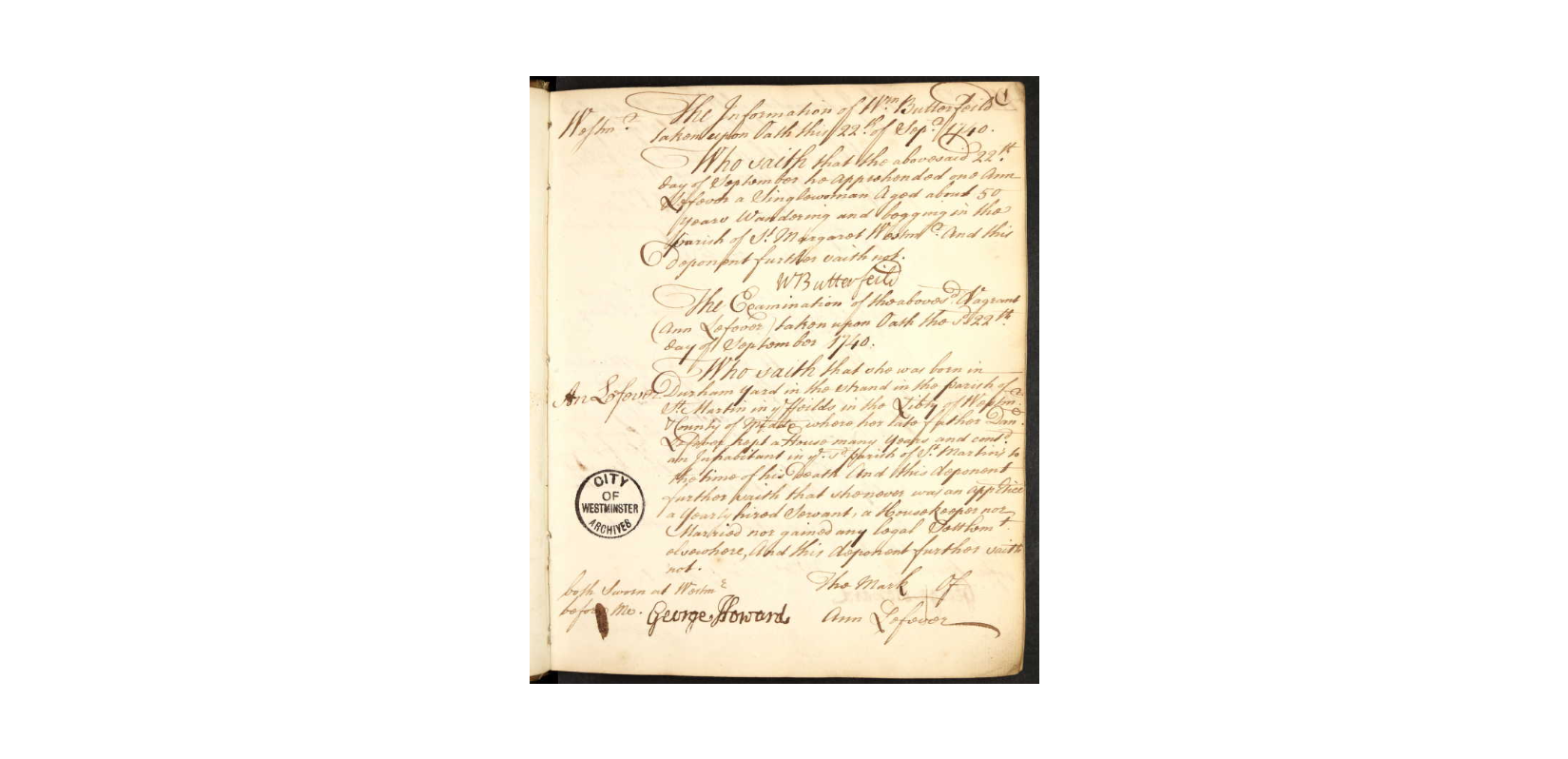
The 1740 settlement examination of Ann Lefever, showing Constable Butterfield's information, Ann's sworn testimony, George Howard's signature, and Ann's mark at the foot of the document

The settlement examination of Ann Lefever, 22 September 1740. Constable William Butterfield's information at the top; Ann's sworn testimony below; George Howard's bold signature and Ann's own mark at the foot. City of Westminster Archives Centre.

Some of the most remarkable lives in the historical record belong to people who left almost nothing behind. No will, no portrait, no letters. Just a small cross beside their name at the foot of a legal document — a mark made by someone who could not write.

Ann Lefever is one of those people. She was born in Westminster in 1697, the daughter of a Huguenot householder in Durham Yard, just off the Strand. She died in the St Martin-in-the-Fields workhouse on 30 May 1756. In between, she left a trail of documents so extensive that it is possible, nearly three hundred years later, to reconstruct the shape of her entire adult life — not because she was famous or powerful, but because the eighteenth-century poor law was extraordinarily good at generating paperwork.

The Document That Started It All

The research began with one document: a vagrancy examination held on 22 September 1740, held at the City of Westminster Archives Centre. Ann Lefever, a singlewoman aged about fifty, had been apprehended by Constable William Butterfield — wandering and begging in the Parish of St Margaret Westminster — and brought before the magistrate George Howard.

Settlement Examination of Ann Lefever, 22 September 1740 — diplomatic transcription

The Information of Wm Butterfeild
Taken upon Oath this 22nd of September 1740.
Who saith that the above said 22th day of September he apprehended one Ann
Lefever a Singlewoman Aged about 50 Years wandering and begging in the
Parish of St Margaret Westminster and this Deponent further saith not.
W Butterfeild


The Examination of the above vagrant (Ann Lefever) taken upon Oath the 22th
Day of September 1740.
Who saith that she was born in Durham yard in the Strand in the parish of
St Martin in the fields in the Liberty of Westminster County of Middlesex
where her late father Daniel Lefever kept a House many years and could
an inhabitant in ye sd parish of St Martins to the time of his Death and this
deponent further saith that she never was an apprentice a yearly hired servant,
a housekeeper nor married nor gained any legal Settlement elsewhere, and this
deponent further saith not.


The mark of Ann Lefever
Both Sworn at Westm
Before me George Howard

Her testimony was precise and legally sophisticated. She had never been apprenticed, never worked as a yearly hired servant, never been a householder, never married. Each denial was a legal statement, establishing that she had acquired no settlement anywhere other than her father's parish. George Howard heard her, accepted her account, and issued a removal order on the same day: Ann Lefever to be conveyed back to St Martin-in-the-Fields.

Transcribing this document opened a question: who was Ann Lefever? The settlement examination is formulaic — designed to elicit specific legal information, not biography. But the details it contained were enough to begin searching.

From One Document to Thirty

The removal order register page for 22 September 1740, showing Ann Lefever's entry among several orders issued by George Howard on the same day

The removal order register, 22 September 1740. Ann Lefever's order sits midway down the page: "Ditto to St Martin in the Fields with Ann Lefever Singlewoman Aged about 50 Years Dated September 22nd 1740 Under the hand & Seal of George Howard Esq." She was one of several people processed by Howard that afternoon.

The baptism register of St Martin-in-the-Fields confirmed her origins: Anne Lefever, born 12 September 1697, baptised 26 September, father Daniel Lefever, mother Mary. She was telling the truth in the examination. Her father really had kept a house in Durham Yard. The parish was genuinely hers by inheritance.

But the far richer discovery came from the Westminster poor law registers — a vast collection held at the City of Westminster Archives Centre. Searching for Ann Lefever returned not one or two records but dozens, spanning 1738 to 1752 and beyond. What emerged was not a woman who had fallen on hard times once. It was a woman who had been cycling in and out of the St Martin's workhouse for the better part of two decades.

The surname Lefever — French for blacksmith, le fèvre — marks the family almost certainly as Huguenot: Protestant refugees who fled Catholic France after 1685 and settled in their tens of thousands across London. Daniel Lefever, Ann’s father, was a householder. Something happened between his life and hers. The records do not say what.

A Life in Cycles

St Martin-in-the-Fields workhouse admissions register showing Ann Lefever's entry with the notation 'Times' indicating repeat admission, alongside her bed number and overseer

The St Martin's workhouse admissions register. Ann's entry carries the notation Times — marking her as a repeat inmate — alongside her bed number and the name of her overseer. The same register records a house population of over 450 inmates in a single fortnight.

The workhouse admission registers are columnar documents, recording each inmate's name, bed number, the number of times they had previously been admitted, and the overseer responsible for them. Ann's very first surviving entry, dated January 1738, already carries the notation Time beside her name. She was a known returner before the surviving registers even begin.

The pattern that emerges across the full run of documents is one of extraordinary persistence. Ann would be admitted to the workhouse, given a bed (often bed 32, almost permanently associated with her name in the registers), stay for weeks or months, be discharged, survive in the community sometimes supported by small outdoor relief payments from the parish — and return.

Selected entries from the St Martin-in-the-Fields workhouse registers

17 January 1738Time — Ann Lefever — age 38 — bed 18 — Mr Dunnall
First surviving entry. Already marked as a repeat inmate.


19 November 17397time — Ann Lefever — bed 32 — [overseer]
Her seventh recorded admission by this date.


23 September 17405time [in this volume] — Ann Lefever — age 39 — bed 32 — Mr Balach
Admitted the day after her examination before George Howard.


24 November 17419time — Ann Lefever — age 40 — Mr T.H. Wood
Her ninth admission in this series of registers.


November 1741 — Summary register — 18 Time — Lefever Ann — age 40
Eighteen admissions recorded across all registers to this point.


6 April 1751 — Ann Lefever — age 60 — arrives — stays until 18 April 1752
Her longest single stay: a full year. She was actually about 53; the estimate of 60 speaks quietly to what the intervening years had cost her.

The September 1740 examination fits precisely into this pattern. She had been discharged from the workhouse in August, wandered into the neighbouring parish of St Margaret's, been apprehended by Constable Butterfield, examined by George Howard, issued with a removal order, and admitted to the workhouse again — all within six weeks, and all within the space of the single document that began this research.

The End of the Record

After 1742, Ann disappears from the registers for nine years. What she was doing between 1742 and 1751 is unknown: perhaps she found some form of stable shelter, perhaps she moved beyond the reach of the Westminster records, perhaps the outdoor relief payments — undated entries in the parish account books — sustained her through this period. When she reappears in April 1751, the registers estimate her age as sixty. She was actually about fifty-three. The gap between the estimate and the reality speaks quietly to what those years had cost.

Her final stay at the workhouse lasted from October 1751 to April 1752 — a full year, her longest single admission. After that, the documents thin. But a death entry in the workhouse register, under the alphabetical summary for the letter L, records the end plainly.

“Times — Lefever Ann — 60 — Died the 30 of May 1756.”

St Martin-in-the-Fields workhouse summary register, under letter L.

Ann Lefever died in the St Martin-in-the-Fields workhouse on 30 May 1756. She was fifty-eight years old, though the register believed her to be sixty. She had been admitted at least eighteen times across the documented period. She had been examined before a magistrate, issued with a removal order, supported with outdoor relief payments, and tracked through half a dozen different register volumes. She could not write her name.

She left no will. She left no descendants. She was buried at parish expense, in a grave that carries no stone.

What Settlement Examinations Can Do

Ann's story illustrates something important about the documents that Heritage Script works with: a settlement examination is almost never just an examination. It is a thread that, when pulled, can unravel a life.

The 1740 document gave us Ann's birthplace, her father's name, her parish, her marital status, and her legal history. From those facts alone, it was possible to find her baptism record confirming her birth in 1697 and identifying her mother Mary; to find dozens of workhouse register entries spanning nearly twenty years; to find the removal order issued on the very same day as the examination; and finally, to find her death.

None of this would have been possible without that first transcription. The secretary hand of the 1740 examination is not easy reading: the contracted legal phrases, the abbreviated words, the careful rendering of Ann's mark at the foot of the page. But once the document is transcribed and its details are in focus, the research possibilities multiply rapidly.

A note on the hand

The examination is written in a clear but compressed mid-eighteenth-century clerk's hand, with heavy use of legal abbreviations and Latin-influenced contractions. The constable's information at the top is in a different, slightly less formal hand than the examination proper, suggesting the two sections may have been written by different clerks. Ann's mark — a simple cross beside her name — appears at the foot of the document, immediately below George Howard's bold, confident signature. The contrast between the two is itself a kind of document.

Ann Lefever made her mark on a September morning in 1740. She could not write, but she could speak, and she spoke carefully, legally, with the precision of someone who had been through this before. Three centuries later, her words have survived. So has her story.

Born: 12 September 1697, Durham Yard, Strand, Westminster  ·  Died: 30 May 1756, St Martin-in-the-Fields Workhouse

Researching London Ancestors?

The Westminster poor law records are among the richest survival series for eighteenth-century London life. Settlement examinations, removal orders, workhouse registers, and outdoor relief accounts together can reconstruct lives that no other archive touches. If you have ancestors in this world — or simply a document you cannot read — Heritage Script offers professional transcription and palaeography services for British historical records from 1550 to 1900.

Every document holds a story. Some of them are extraordinary.

Request a Free Sample Transcription

Primary Sources

All records are held at or accessed via the City of Westminster Archives Centre, made available digitally through Ancestry.co.uk. The settlement examination of Ann Lefever (22 September 1740) forms part of the Heritage Script transcription portfolio. The baptism register of St Martin-in-the-Fields (1697), workhouse admissions registers (1738–1756), workhouse summary registers, outdoor relief account books, and the removal order register for 22 September 1740 were all consulted. The death date of 30 May 1756 is recorded in the workhouse summary register under the letter L.

Filed under:   Settlement Examinations Poor Law Westminster Workhouse Vagrancy Huguenot 18th Century London

Have a Document That Tells a Story?

Send me your historical document for a free sample transcription and no-obligation consultation.

Request Your Consultation