About Heritage Script

I've spent 30 years in legal transcription, including secretarial and document production work at some of London's most prestigious law firms. During those decades, I became intimately familiar with legal language, document structures, and the peculiarities of historical legal writing — the foundation of my palaeography and transcription work today.

But my real passion has always been family history. I understand the frustration of finding a crucial document — especially for researchers in the USA, Australia, and Canada who've traced British ancestry but cannot read secretary hand or other historical scripts from the 16th–19th centuries.

That's why I founded Heritage Script — a specialist palaeography and transcription service. Based in West Sussex, England, I'm perfectly positioned to provide accurate transcriptions of British historical documents for genealogy researchers worldwide.

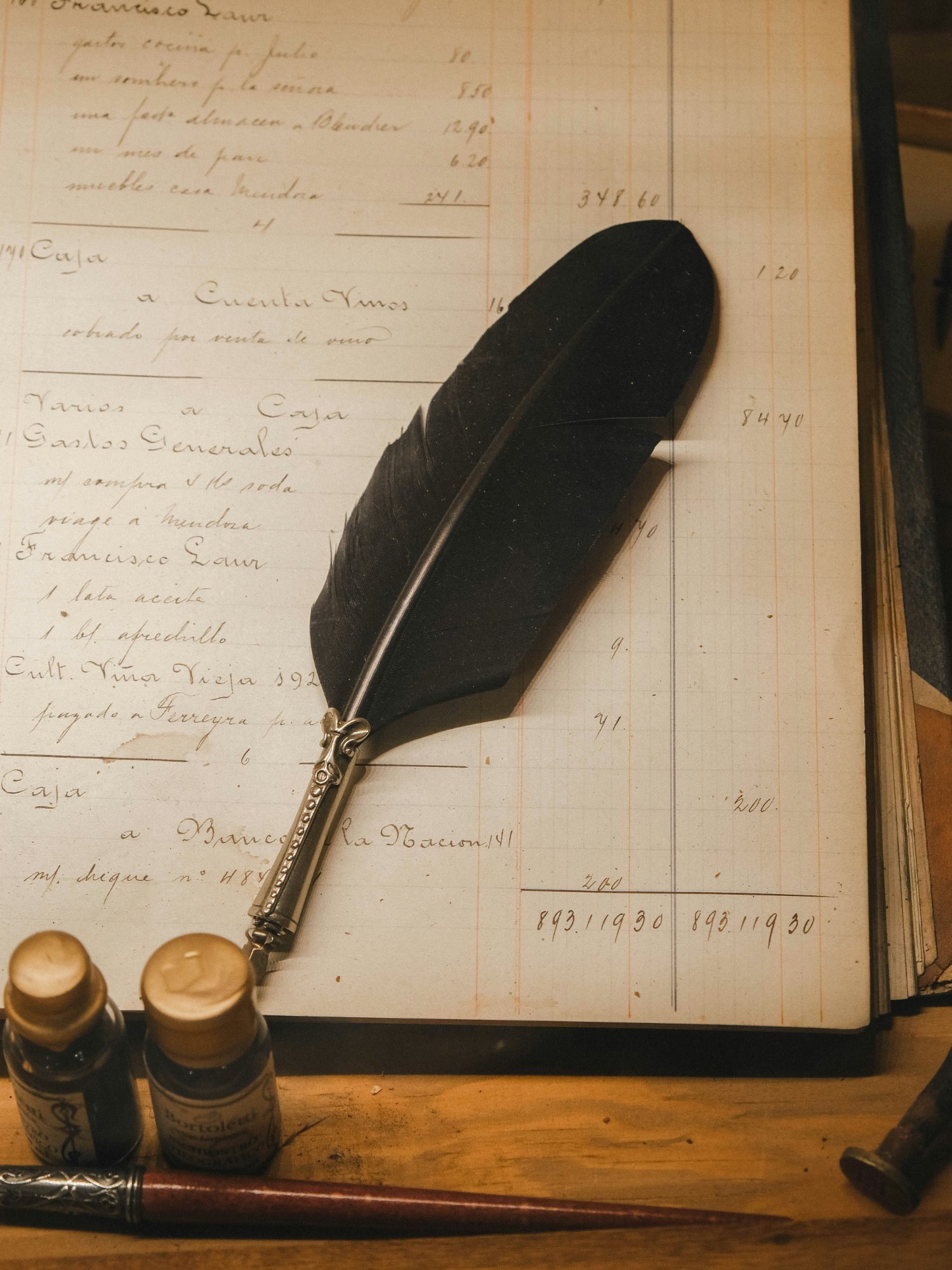
Historical ledger with quill pen and ink

My Expertise

Legal Background

30 years' experience in legal transcription, including document production and secretarial work at some of London's top law firms, giving me a working command of legal terminology, document conventions, and the archaic legal language found in wills, deeds, and court records.

Palaeography Skills

Trained in reading historical handwriting styles including secretary hand, court hand, and various 16th–19th century scripts — see the Glossary for explanations of all major hands. What reads as illegible to a non-specialist is, for the most part, a familiar and decipherable script to a trained eye.

Research-Aware Transcription

As an active family historian myself, I understand what information matters to researchers, and flag names, dates, and places likely to be significant to your research rather than transcribing without that context.

Note: I provide transcription services only. I am not a trained genealogist and do not offer research services or advice on research strategy.

Attention to Detail

Palaeographic work demands precision. Every name, date, and place could be significant to your research, so uncertain readings are always marked clearly, and you'll know exactly what's definite and what may need further verification. Getting a word exactly right often means painstaking, repeated proofreading against the original — it takes time, but it's effort I believe is always worth it.

Local Knowledge

Based in West Sussex, with particular expertise in Sussex and South-East England records, and experience working with clients across the UK, Ireland, and the wider English-speaking world researching British ancestry.

Professional Standards

Every document is treated with strict confidentiality, and every transcription is checked against the original before it's sent to you — accuracy and discretion you can rely on.

Professional Affiliations

Sussex Family History Group

Active member of the Sussex Family History Group, engaged with the family history community and committed to maintaining the highest professional transcription standards.

The National Archives

Volunteer transcriber for The National Archives, contributing to making Britain's historical records accessible to researchers worldwide.

Published Work

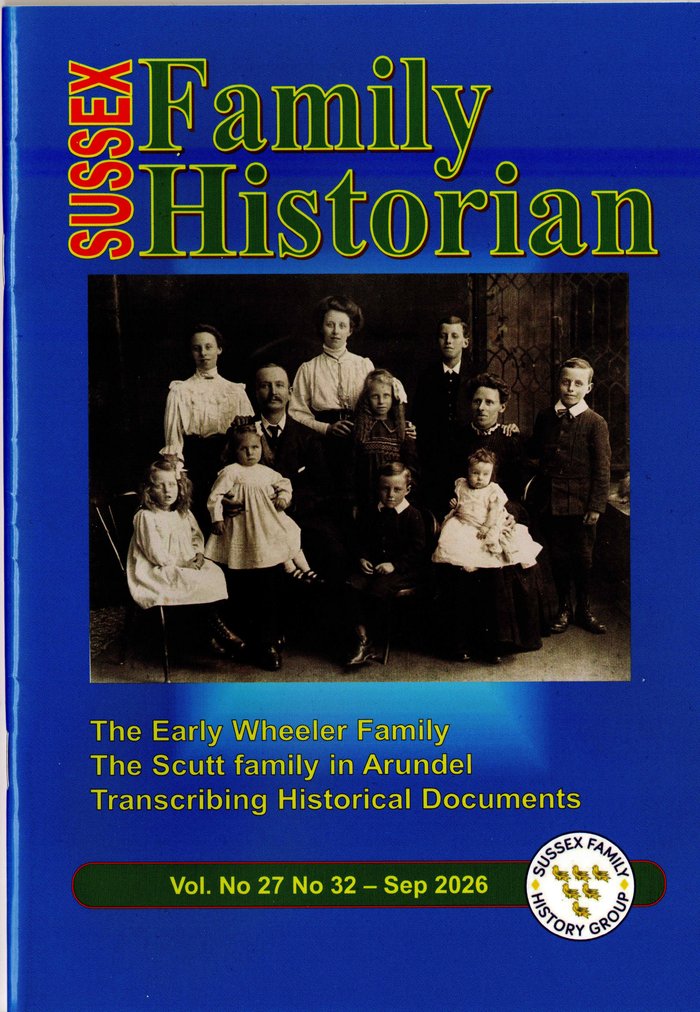
Sussex Family Historian, Vol. 27 No. 3, September 2026 — magazine cover

Transcribing Historical Documents

Sussex Family Historian, Vol. 27 No. 3, September 2026

A preview of the research behind this article is available now: The Money Man of the Hawkhurst Gang: What a Will Reveals →

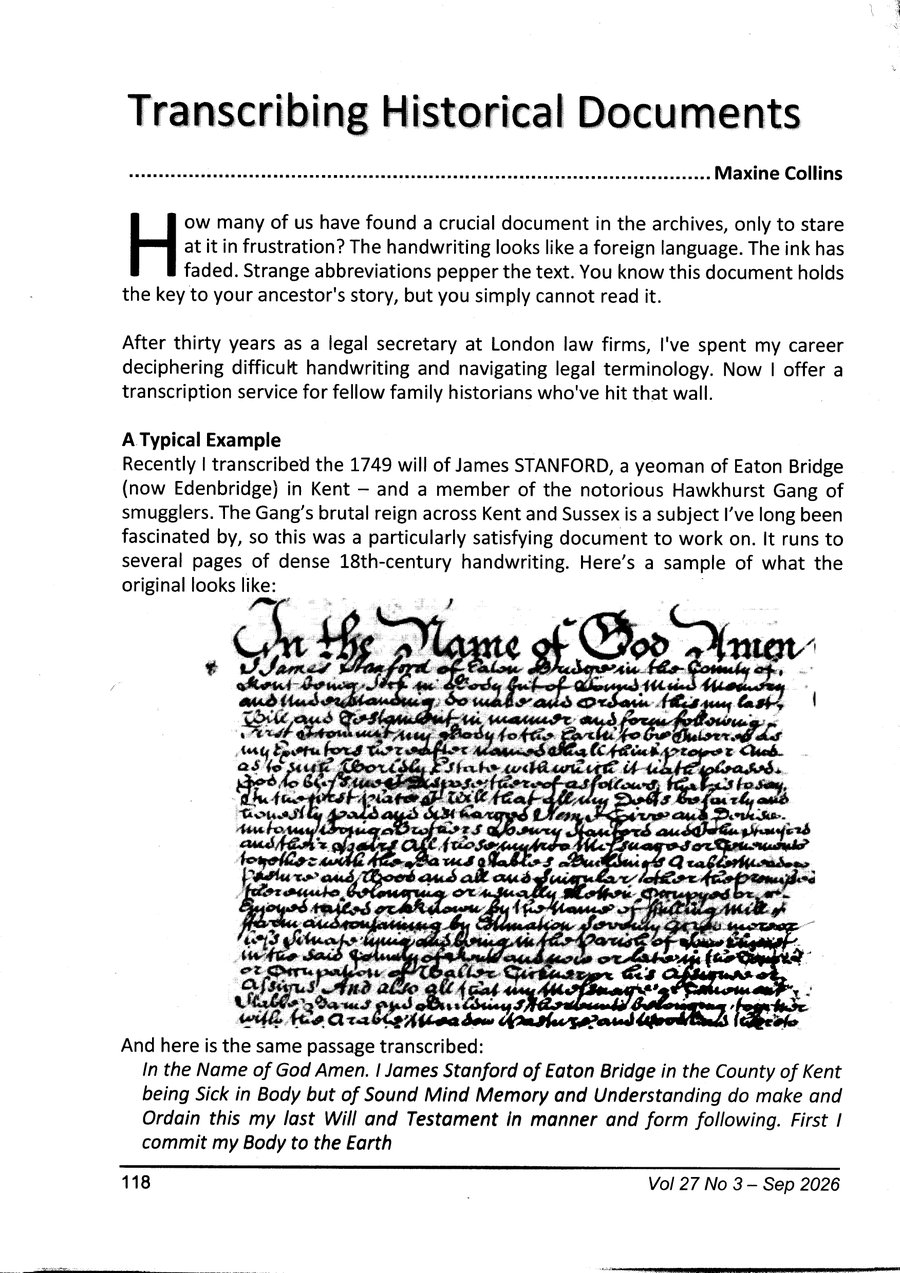
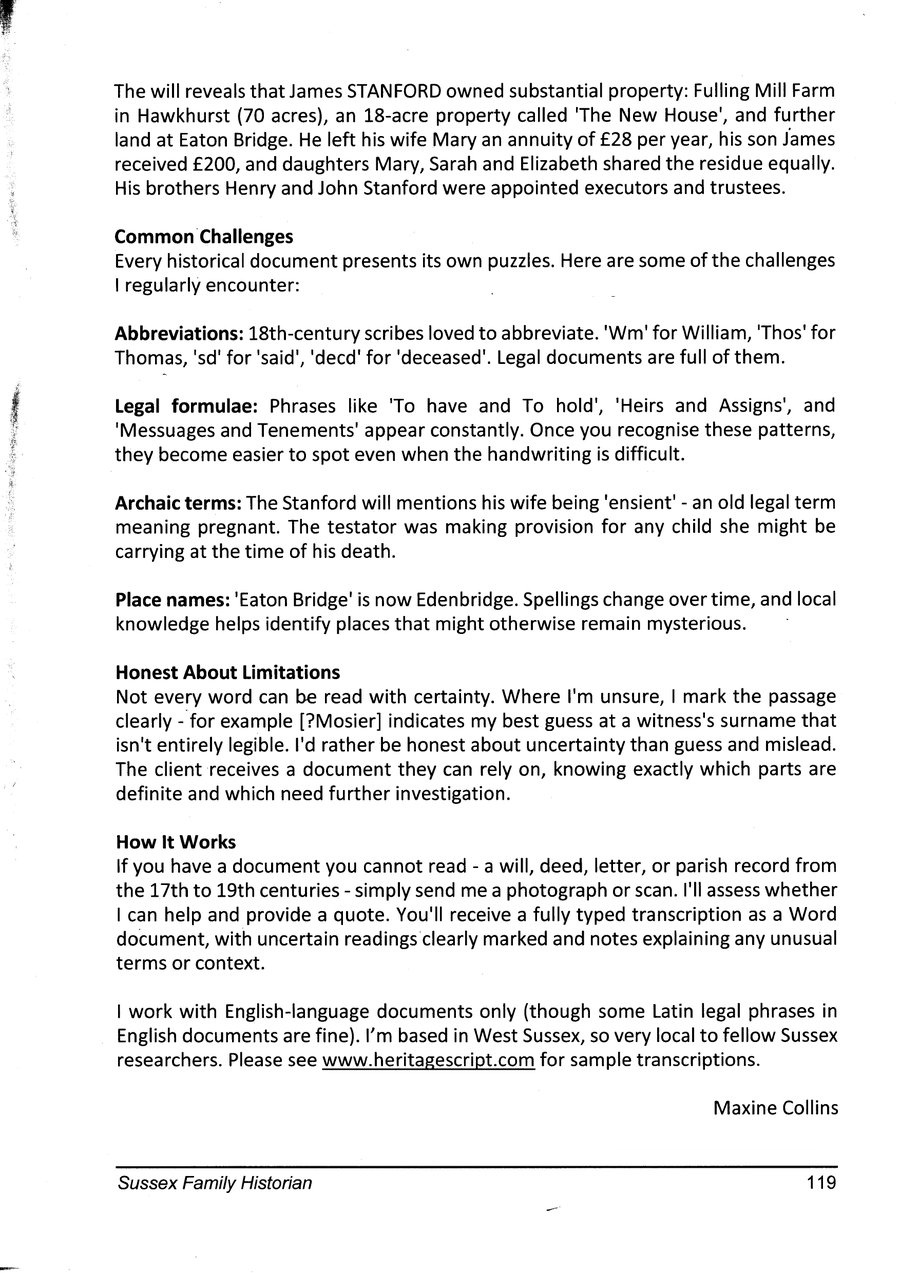
Transcribing Historical Documents, page 118, Sussex Family Historian Transcribing Historical Documents, page 119, Sussex Family Historian

How many of us have found a crucial document in the archives, only to stare at it in frustration? The handwriting looks like a foreign language. The ink has faded. Strange abbreviations pepper the text. You know this document holds the key to your ancestor's story, but you simply cannot read it.

After thirty years as a legal secretary at London law firms, I've spent my career deciphering difficult handwriting and navigating legal terminology. Now I offer a transcription service for fellow family historians who've hit that wall.

A Typical Example

Recently I transcribed the 1749 will of James Stanford, a yeoman of Eaton Bridge (now Edenbridge) in Kent – and a member of the notorious Hawkhurst Gang of smugglers. The Gang's brutal reign across Kent and Sussex is a subject I've long been fascinated by, so this was a particularly satisfying document to work on. It runs to several pages of dense 18th-century handwriting.

In the Name of God Amen. I James Stanford of Eaton Bridge in the County of Kent being Sick in Body but of Sound Mind Memory and Understanding do make and Ordain this my last Will and Testament in manner and form following. First I commit my Body to the Earth…

The will reveals that James Stanford owned substantial property: Fulling Mill Farm in Hawkhurst (70 acres), an 18-acre property called ‘The New House’, and further land at Eaton Bridge. He left his wife Mary an annuity of £28 a year, his son James received £200, and his daughters Mary, Sarah and Elizabeth shared the residue equally. His brothers Henry and John Stanford were appointed executors and trustees.

Common Challenges

Every historical document presents its own puzzles. Here are some of the challenges I regularly encounter:

Abbreviations: 18th-century scribes loved to abbreviate – ‘Wm’ for William, ‘Thos’ for Thomas, ‘sd’ for ‘said’, ‘decd’ for ‘deceased’. Legal documents are full of them.

Legal formulae: Phrases like ‘To have and To hold’, ‘Heirs and Assigns’, and ‘Messuages and Tenements’ appear constantly. Once you recognise these patterns, they become easier to spot even when the handwriting is difficult.

Archaic terms: The Stanford will mentions his wife being ‘ensient’ – an old legal term meaning pregnant. The testator was making provision for any child she might be carrying at the time of his death.

Place names: ‘Eaton Bridge’ is now Edenbridge. Spellings change over time, and local knowledge helps identify places that might otherwise remain mysterious.

Honest About Limitations

Not every word can be read with certainty. Where I'm unsure, I mark the passage clearly – for example [?Mosier] indicates my best guess at a witness's surname that isn't entirely legible. I'd rather be honest about uncertainty than guess and mislead. The client receives a document they can rely on, knowing exactly which parts are definite and which need further investigation.

How It Works

If you have a document you cannot read – a will, deed, letter, or parish record from the 17th to 19th centuries – simply send me a photograph or scan. I'll assess whether I can help and provide a quote. You'll receive a fully typed transcription as a Word document, with uncertain readings clearly marked and notes explaining any unusual terms or context.

I work with English-language documents only (though some Latin legal phrases within English documents are fine). I'm based in West Sussex, so very local to fellow Sussex researchers. Please see www.heritagescript.com for sample transcriptions.
Let's Work Together

Whether you have a single frustrating document or a whole archive to decode, I'm here to help.

Get in Touch