Case Study · Wills & Probate · Kent · February 2026
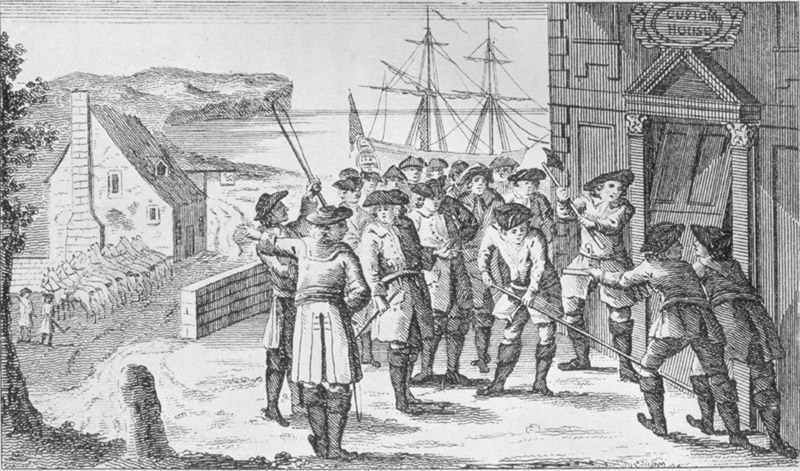
The Hawkhurst Gang raiding Poole Customs House, 1747 — the raid that made the gang notorious throughout England
I chose the Stanford will deliberately for the Heritage Script sample page — my long-standing interest in the Hawkhurst Gang made it an obvious choice, a document that sits at the intersection of legal history and one of the most notorious criminal enterprises in Georgian England. What I did not anticipate was where the subsequent research would lead.
On the surface, the will of James Stanford is an unremarkable document of its type. A sick man in Eaton Bridge — the period spelling of Edenbridge — disposes of his worldly estate: two farms in Hawkhurst, a messuage at Edenbridge, some seventy acres here, eighteen there. He names his brothers. He provides for his wife and children. The legal formulae are standard. The secretary hand is clear and well-formed.
And yet behind the measured language of this 1760 document lies one of the more colourful stories in the history of Georgian Kent.
The will opens with the familiar testament preamble before moving swiftly to the disposal of his estate. What is immediately striking is the scale of what Stanford had accumulated. Fulling Mill Farm in Hawkhurst, of some seventy acres, was leased to a Walter Kirton. The New House, eighteen acres, had been in Stanford's own occupation. A third property at Eaton Bridge itself was also his. These are not the holdings of a small tradesman.
The will of James Stanford, 18 January 1760 — click to enlarge
Extract — James Stanford's Will, 18 January 1760
Item I Give and Devise unto my loving Brothers Henry Stanford and John Stanford and their Heirs All those my two Messuages or Tenements together with the Barns Stables Buildings Arable Meadow Pasture and Wood... called or known by the Name of Fulling Mill Farm and containing by Estimation Seventy Acres more or less Situate lying and being in the Parish of Hawkhurst in the said County of Kent...
The brothers named as trustees — Henry Stanford and John Stanford — are the key figures around whom the family story turns. They are not merely legal functionaries; they are the men to whom James entrusts everything, and their names echo through the genealogical record of Edenbridge for generations.
Research into the Stanford family of Edenbridge and Hawkhurst reveals that James was, in all probability, the financial operator known among the smuggling fraternity as "Stanford Trip" — the so-called money man of the notorious Hawkhurst Gang.
While other gang members took the physical risks of running contraband tea, brandy and tobacco across the Channel, James managed the finances, laundered profits through legitimate property investments, and moved with ease between the criminal underworld and respectable Kentish society.
His father, John Stanford, had been a mercer in Edenbridge — a respectable tradesman who took over the drapery business from one Ellis Jenner and served as parish overseer, a mark of solid community standing. James grew up behind a shop counter, learning the names of fabrics and the arithmetic of trade. He learned something else too: that the Weald of Kent had a shadow economy, and that it paid rather better than honest merchandise.
By his twenties, James had become the financial architect of what would become one of the most feared criminal organisations in eighteenth-century England. He purchased Ockley Farm in Hawkhurst — the property with the fulling mill that appears in his will — which served simultaneously as a legitimate investment, a storage location for contraband before distribution, and a mechanism for laundering his profits. In 1754 he leased the mill to a papermaker named Edward Blackwell, who converted it to paper production; a business that outlasted the gang by decades.
When he came to write his will in January 1760, facing legal scrutiny and declining health, James described himself simply as a gentleman of Eaton Bridge. The will was proved on 3 April 1761.
John Stanford, the mercer and James's father, was himself the son of a Henry Stanford recorded in the Edenbridge parish register — with a son John baptised there on 15 July 1668. The Stanford presence in Edenbridge stretches back considerably further. The same parish register volume records a cluster of Stanford marriages in the 1570s and 1580s that reveals an already well-established family in the parish.
Married Joane Spacherst
9 December 1577, Edenbridge
Married George Pearse
10 July 1579, Edenbridge
Married Joane Hayward
13 September 1585, Edenbridge
All three appear in the same parish register volume (FHL 942.23 C4KA V.21), within an eight-year window. Whether they were siblings, cousins, or more distant relations sharing the parish remains a matter for further archival investigation — their clustering in the same register points strongly to a single established Stanford household, but this has not yet been proven from documentary evidence, and the relationship between them remains circumstantial.
Henry Stanford (active Edenbridge, 1585)
↓
[intermediate generation — not yet confirmed]
↓
Henry Stanford (father of John, baptised Edenbridge 15 July 1668)
↓
John Stanford (mercer of Edenbridge, born c.1668, married Mary)
↓
James Stanford (born c.1710–1716, Hawkhurst Gang, died 1761)
Genealogical research has a way of becoming unexpectedly personal. Investigating the Stanford family of Edenbridge following the transcription of this will has raised a possibility that cannot yet be stated as fact, but which is sufficiently supported by the evidence to be worth recording here. I should say plainly that I am not a genealogist — I am an enthusiastic if time-poor amateur at best — so the connections proposed below represent personal research rather than professional analysis, and should be read in that spirit.
A William Stanford, documented in Kent before 1530, is my own 15th great-grandfather — connected to my family through his daughter Margaret, who married into the Pattenden family. The evidence gathered from the Edenbridge parish registers suggests, tentatively, that the same William Stanford may be the common ancestor from whom the broader Edenbridge Stanford line also descends: through a separate male branch that persisted in the parish across the generations, producing Henry, then John the mercer, and ultimately James himself.
If that connection is ever confirmed by documentary evidence — a will at the Kent History and Library Centre, perhaps, or a baptism record that bridges the gap — then the man whose will is transcribed above would be a very distant collateral relative of the person who transcribed it.
It is, for now, a pleasing hypothesis rather than a proven genealogy. But it serves as a reminder of something central to this work: that the documents on the desk are never entirely abstract. Behind every will, every parish register entry, every settlement examination, there are real people whose lives connect — sometimes in ways that reach across the centuries to touch our own.
The transcriber's task is to recover those connections, faithfully and honestly, and to release the stories that the documents have been holding in trust.
The Stanfords of Edenbridge are, for now, an open case — and the right document in the right hands has a way of unlocking everything.
If you are researching the Stanford family of Edenbridge, Hawkhurst, or the wider Kentish Weald; if you have encountered the name Stanford in connection with the Hawkhurst Gang; or if you hold documentary evidence that might confirm or challenge any of the connections proposed here — particularly anything relating to the Stanford family in Edenbridge between 1530 and 1640 — I would be genuinely delighted to hear from you. Genealogy is, at its best, a collaborative discipline.
Get in TouchA Note on Sources
The account of James Stanford's life draws on historical research into the Hawkhurst Gang and the Stanford family of Edenbridge and Hawkhurst, Kent. The will itself — James Stanford of Eaton Bridge, proved 3 April 1761 — is a primary document. The genealogical connections proposed here are supported by parish register evidence from the Edenbridge registers (FHL 942.23 C4KA V.21) and related Ancestry collections, but the deeper connections to William Stanford (pre-1530) remain unconfirmed pending further archival research at the Kent History and Library Centre, Maidstone.
Filed under: Wills & Probate Kent 18th Century Hawkhurst Gang
Send me your historical document for a free sample transcription and no-obligation consultation.
Request Your Consultation