Ancestor Stories · Archives · Shelley · February 2026
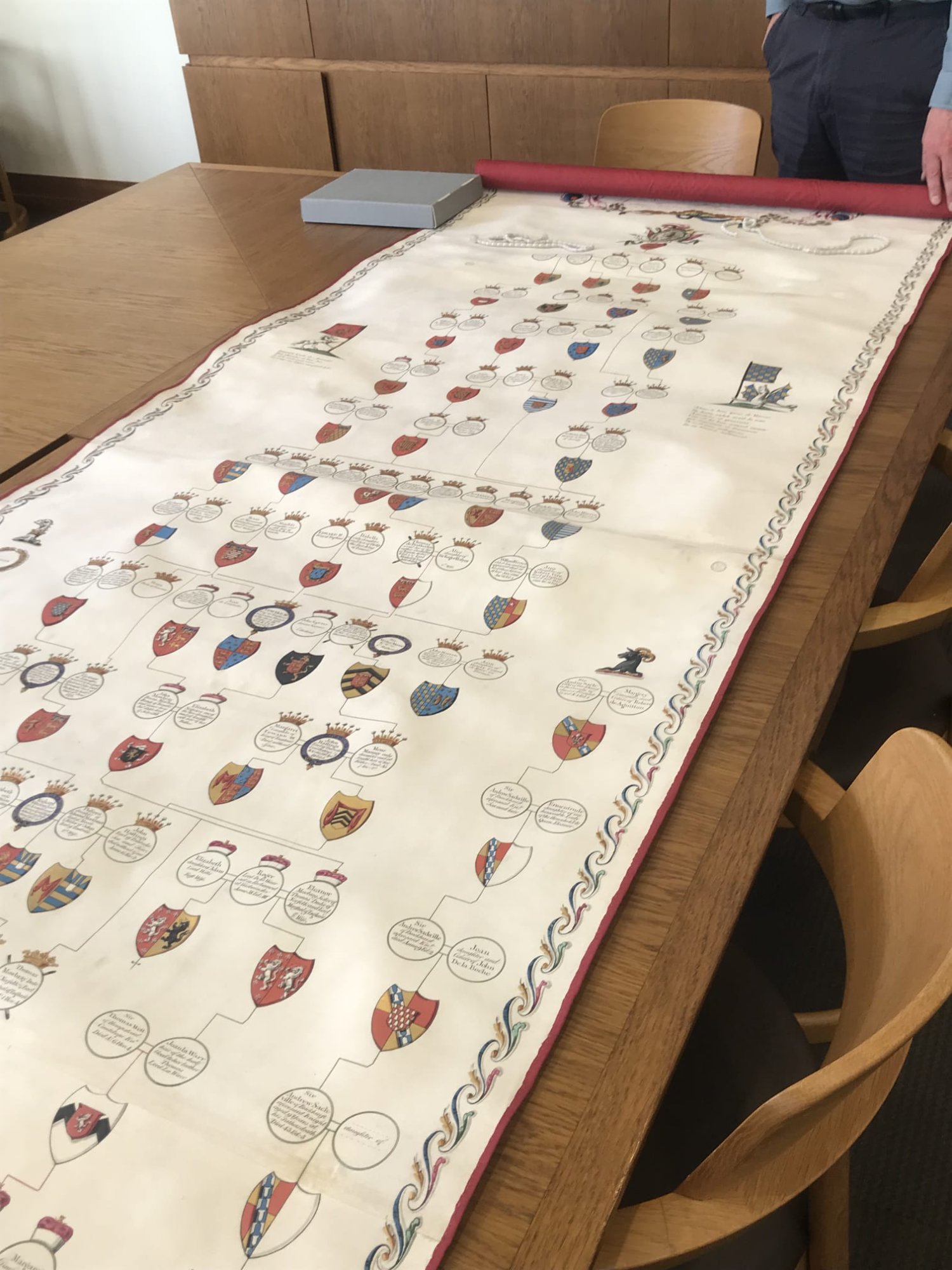
The Bysshe-Shelley family scroll, partially unrolled at the Bodleian Library. Commissioned by Sir Bysshe Shelley, 1st Baronet — Percy's grandfather — it traces the family's lineage back to William the Conqueror across twenty feet of illuminated vellum.
There are days in genealogical research that stay with you. Days when the names you have spent months tracing through parish registers and census returns suddenly become physical — not entries in a database but objects you can reach out and touch. My visit to the Bodleian Library in Oxford was one of those days.
I went to view the Shelley-Bysshe Collection. What I had not entirely prepared myself for was how personal it would become.
The visit was arranged through Stephen Hebron, Curator of Special Projects at the Bodleian Library, whose research specialisms in Romantic Period literature and the history of the book made him an extraordinarily knowledgeable guide to what we were about to see. Stephen is the kind of curator who has clearly never tired of the objects in his care, and who understands that showing someone a manuscript for the first time is a particular kind of privilege.
We were shown three things. Each was remarkable in its own right. Together, they amounted to one of the most extraordinary afternoons I have spent in an archive — and I have spent a great many afternoons in archives.
Stephen unrolled it carefully across the full length of the table — and kept unrolling. Twenty feet of illuminated vellum, bordered in red and gold, filled with heraldic shields painted in vivid reds, blues, and golds, each family member contained within their own carefully calligraphed roundel, connected by elegant lines stretching back through the centuries.
This was the family tree commissioned by Sir Bysshe Shelley, 1st Baronet — Percy's grandfather — who was famously consumed by a desire to establish and celebrate his family's noble lineage. The scroll traces the Bysshe and Shelley lines back, generation by generation, to William the Conqueror. It is as much a work of art as a genealogical document: the heraldic shields individually painted with the correct arms and charges, the calligraphy meticulous throughout.
The scroll unrolled to its full extent across the reading room table — heraldic shields, calligraphed roundels, and a decorative red and gold border running the full length of the vellum.
I was allowed to touch it. Running my fingers along the painted vellum, I was acutely aware that somewhere on this scroll was my own family. My line connects through Sarah Bysshe (1696–1732), born in Burstow, Surrey, who married William Pattenden of West Hoathly and became my 7x great-grandmother. The Bysshe family that Sir Bysshe was so proud to commemorate in this extraordinary object is also my family — and his obsession with establishing the lineage was, in a very real sense, establishing mine too.
Percy Bysshe Shelley's middle name was not a literary affectation. It was his grandmother's maiden name — the same surname, from the same Sussex and Surrey family, that appears in my own tree through the West Hoathly Pattendens. The scroll was, in a very real sense, part of my story too.
If you'd like to read more about this genealogical connection in detail: A Name in the Tree: Following the Bysshe Line to Percy Shelley →
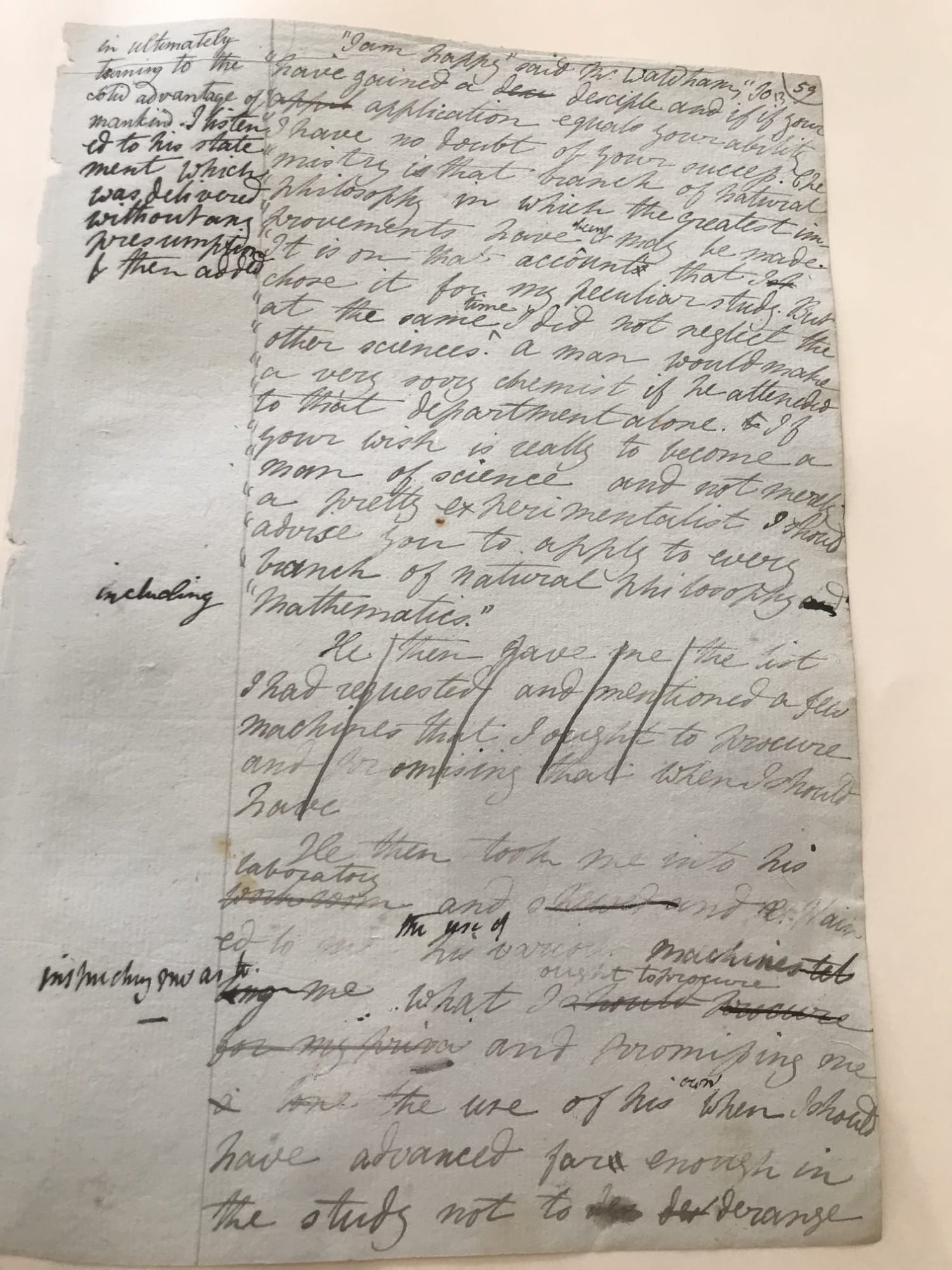
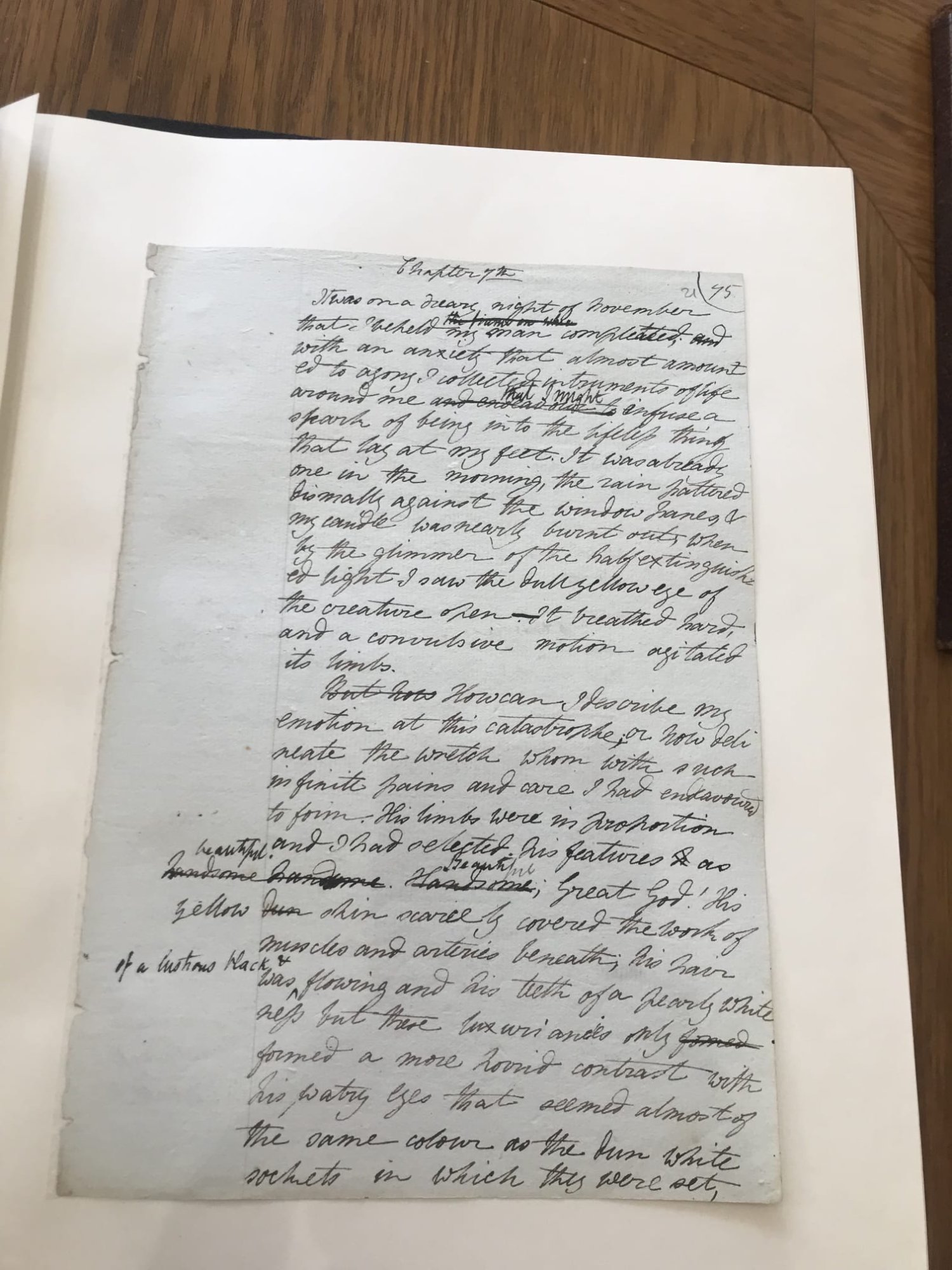
Next came the Frankenstein manuscript. Mary Shelley was nineteen years old when she wrote it, and here were the pages to prove it — loose sheets of thin paper, covered in her flowing, urgent hand, with crossings-out and revisions visible throughout. The corrections make it feel startlingly alive: a young woman's mind moving fast, second-guessing herself, pressing forward.
Mary Shelley's draft — her hand urgent and forward-moving, with corrections woven through the text.
Chapter 7 — "It was on a dreary night of November..." — the creation scene. The crossings-out and rewrites are visible throughout.
I did not dare touch these. There is something about Mary Shelley's manuscript that feels almost too sacred — the paper on which one of the most influential novels in literary history was first written out, in the hand that wrote it, by a teenager. Looking at the Chapter 7 creation scene with its crossings-out intact, you are watching the monster being born in real time.
On the manuscript
The Bodleian holds the main draft manuscript of Frankenstein; or, The Modern Prometheus, largely in Mary Shelley's hand with some passages in Percy's, written 1816–17 when Mary was 18 and 19 years old. First published anonymously in 1818. The corrections and revisions in the original bring home the fact — sometimes obscured by the novel's subsequent cultural weight — that this was a young woman working through an idea on paper, not a monument arriving fully formed.
As a professional palaeographer, I spend my working days reading and transcribing historical handwriting. I like to think I can read most things. Sitting in that quiet room at the Bodleian, I found myself simply looking rather than reading — just taking in the fact of it.
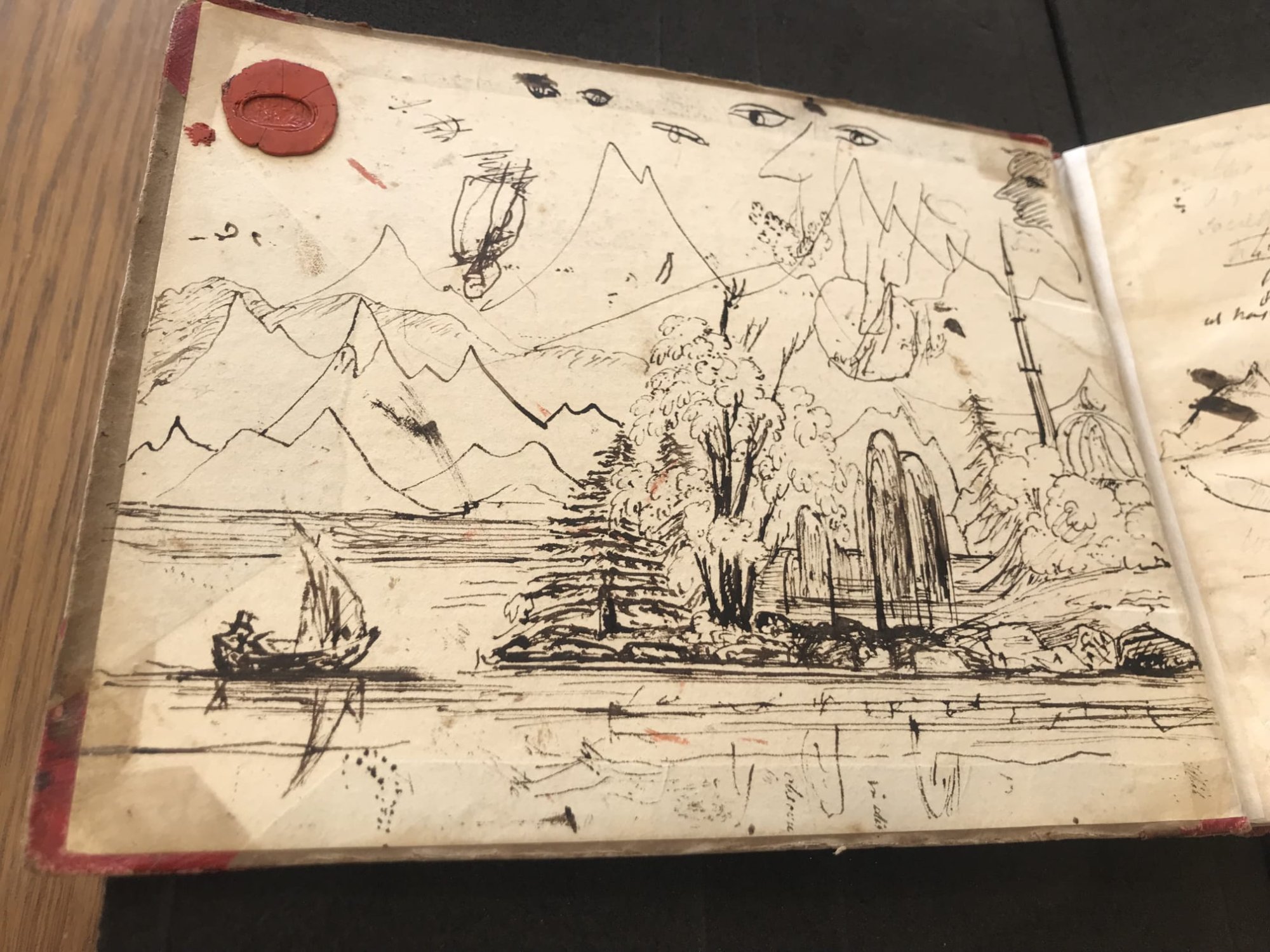
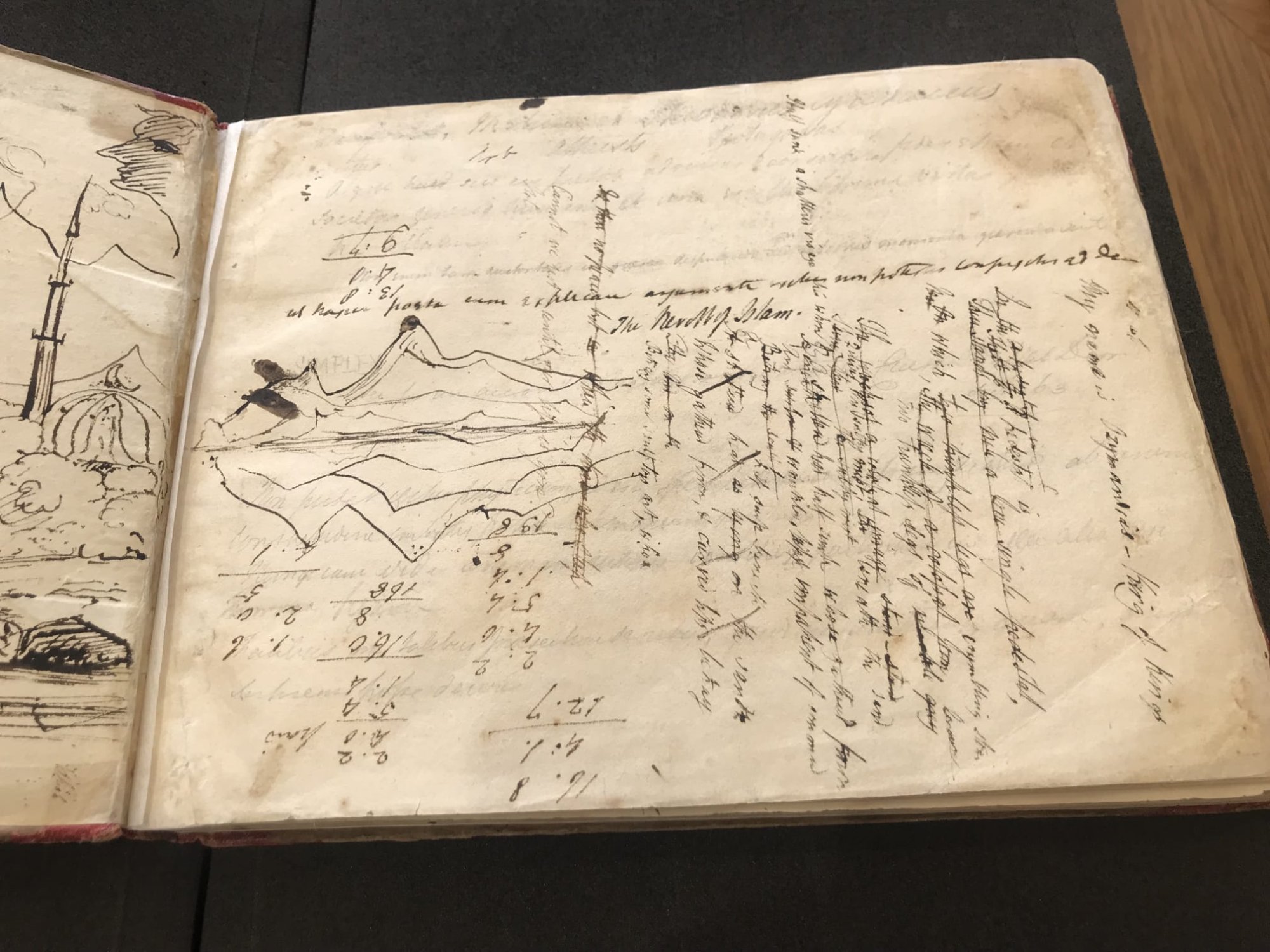
Percy's notebooks were different in character again. Where the Frankenstein manuscript has an almost reverential quality, these are wonderfully chaotic — the working space of a restless, tumbling mind. Poetry shares the page with arithmetic; landscape sketches jostle with draft lines; doodles of mountains and sailing boats appear between stanzas. The red wax seal on one cover is still intact.
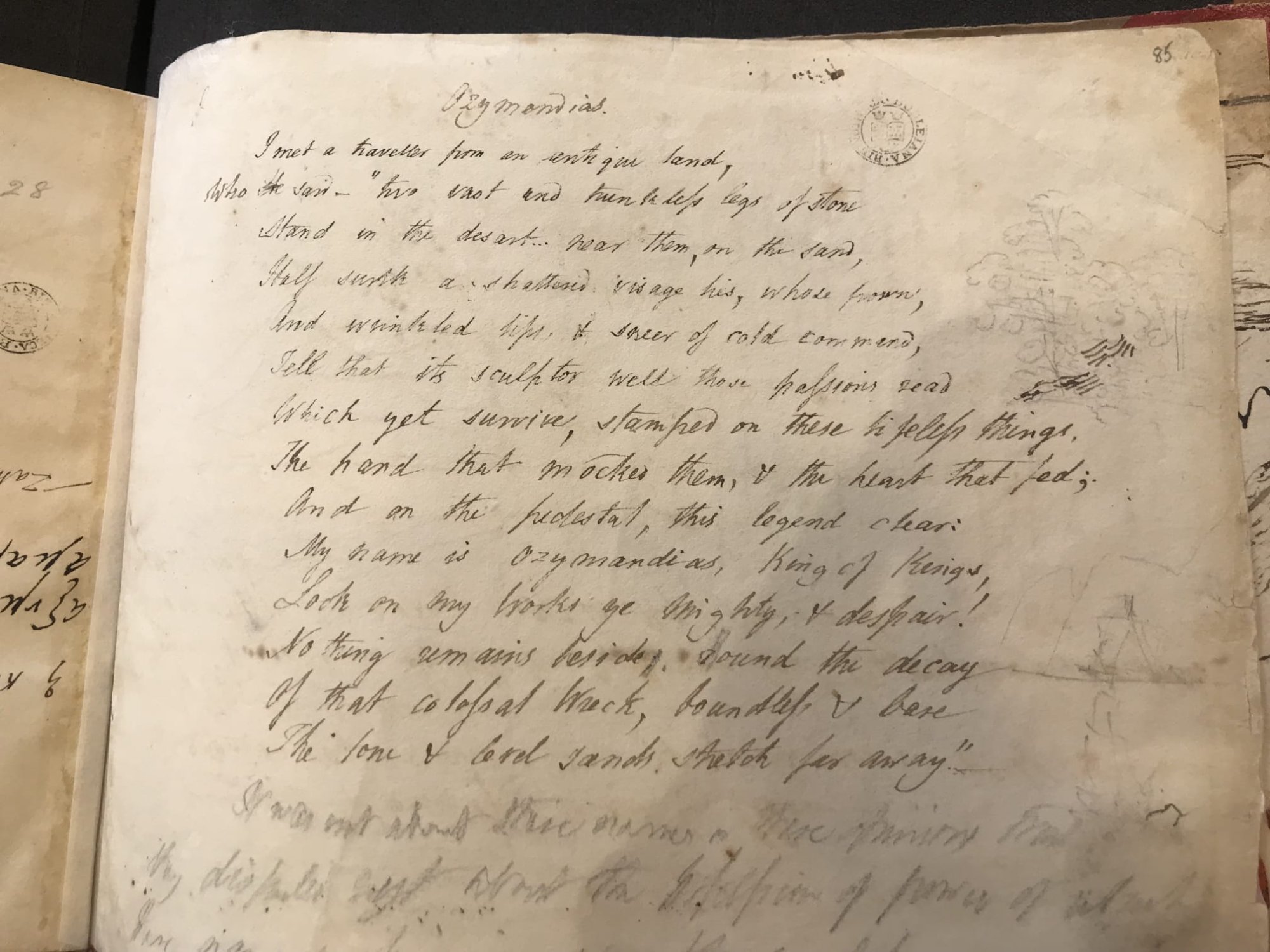
Ozymandias in Percy's hand — the whole poem on a single page, numbered 85. The sketch in the margin appears to be a tree or plant study.
The notebook cover: an elaborate alpine lake scene in pen and ink — mountains, pine trees, a sailing boat — with the original red wax seal still intact in the upper left corner.
One page stopped me completely. Written in Percy's elegant, slightly italic hand, titled simply Ozymandias — the whole poem there on a single page. The thick, textured paper of these notebooks is completely distinctive. When Stephen allowed me to touch them, that surface felt like a direct physical connection across two centuries. You could almost hear a quill scratching across it.
A characteristic spread: the title The Revolt of Islam sits among mountain sketches, draft verse in multiple languages, and columns of arithmetic — all on the same page.
There is something particular about handling the actual physical object that no facsimile or digital reproduction can replicate. As someone whose work is built around the belief that original documents carry meaning that transcription alone cannot fully convey, that afternoon at the Bodleian confirmed everything I believe about why primary sources matter.
I founded Heritage Script to help people connect with their own historical documents — the wills, parish registers, legal papers, and letters that record the lives of ancestors in their own handwriting. Most of those documents will never be as famous as Frankenstein or Ozymandias. But to the families they concern, they are just as precious.
My afternoon at the Bodleian reminded me of something easy to lose sight of in the day-to-day work of transcription: genealogical research is not ultimately about names and dates. It is about the physical, tangible traces that people leave behind. A signature in a marriage register. A mark made by an illiterate ancestor at the foot of a will. A twenty-foot scroll of painted vellum connecting a Sussex family to the Norman Conquest.
Every document tells a story. My job — and privilege — is helping people read theirs.
With thanks
My sincere thanks to Stephen Hebron, Curator of Special Projects at the Bodleian Library, whose research interests in Romantic Period literature and the history of the book made him an exceptional guide to these extraordinary objects. The Bodleian's Shelley-Bysshe Collection is one of the great literary and genealogical holdings in any British library, and Stephen's generosity in arranging and guiding this visit is something I will not forget.
The Surrey-Sussex borderlands are particularly well served by surviving parish records — Burstow, West Hoathly, Ardingly, Worth, and the surrounding parishes all have registers reaching back into the sixteenth and seventeenth centuries. If you have Bysshe, Pattenden, Shelley, or related names in your tree, the records are there to be read.
If you need help with the handwriting — secretary hand from this period can be formidable — Heritage Script offers professional transcription and palaeography services for British historical documents from 1550 to 1900.
Request a Free Sample TranscriptionA Note on the Collection
The Shelley-Bysshe Collection is held at the Bodleian Library, University of Oxford. The illuminated family scroll was commissioned by Sir Bysshe Shelley, 1st Baronet (1731–1815). The Frankenstein draft manuscript (MS. Abinger c.56 and related volumes) is largely in Mary Shelley's hand with some passages in Percy Shelley's, written 1816–17, first published anonymously in 1818. Percy Shelley's notebooks (MS. Shelley adds. series) are among the most significant holdings of Romantic manuscript material in any British institution. Enquiries regarding access to the collection should be directed to the Bodleian Library Special Collections reading room. The personal genealogical connection through Sarah Bysshe (1696–1732) of Burstow, Surrey, is described in detail in A Name in the Tree: Following the Bysshe Line to Percy Shelley.
Filed under: Archives Shelley Bysshe Sussex Bodleian Library Manuscripts Family History
Send me your historical document for a free sample transcription and no-obligation consultation.
Request Your Consultation