Some surnames are scattered so widely across a region that they become almost invisible — familiar to every genealogist, attached to seemingly half the entries in the Kentish parish registers, yet rarely examined as a story in themselves. The Pattendens are one such family. With over 10,500 documented individuals since the thirteenth century, the name is one of the most consistently traceable locational surnames in the English Weald — and for many researchers working the Kent and Sussex registers, it is practically impossible to avoid.
It is also my family. My great-grandmother was a Pattenden by birth, and when I began tracing that line I quickly understood why the surname appears so often in my tree: this is a family that stayed, generation after generation, within a remarkably tight arc of the Weald — Kent into East Sussex, East Sussex back into Surrey — for centuries, before the railways eventually scattered them further afield. What I found was not just a lineage but a community, with deep roots in the landscape itself.
A Name from the Land
The surname Pattenden is locational in origin — meaning it derives not from a personal characteristic or occupation, but from a place. That place was Pattyndenne Manor in Goudhurst, Kent, together with the manors of Great and Little Pattenden at Marden, both situated in the deep Weald. The name survives today in Pattenden Lane, Marden — all that physically remains of the two lesser manors. Pattyndenne Manor itself, built in 1470 at the foot of a hill beside a stream, still stands as a private family home: a remarkable continuity across more than five and a half centuries.
The etymology rewards a little attention. The element denn — often written denne in early records — is an Old English term for a woodland swine pasture, particularly associated with the Kentish Weald, where pigs were driven into the forest each autumn to fatten on mast. You still see it in dozens of Kentish place-names: Tenterden, Biddenden, Benenden, Rolvenden. Paired with a personal name — most likely the Old English Peatta, or possibly a short form of Patrick — it gives us "Peatta's woodland pasture." This is a name that preserves, in its very syllables, a way of life: pannage rights, woodland management, the rhythms of a pastoral economy that shaped the Weald for a thousand years.
There is a further possibility worth noting. The Saxon word patta can mean a stream with a tendency to swell — and Pattyndenne Manor sits at the bottom of a hill by precisely such a stream, making the topographic reading equally plausible. Place-name derivations are rarely simple, and the Pattenden name may carry both meanings simultaneously.
By 1396, Nicholas Patynden was living in Cranbrook, already some miles from the original manors. By 1464, Bartholomew Pattenden appears in Staplehurst — the first recorded use of the modern spelling. Pattyndenne Manor was built in that same decade, fixing the family seat at Goudhurst where the name had already been rooted for two centuries. The family were spreading across the Weald, following the ancient network of drove roads and market towns that connected the Kentish parishes.
Henry Pattenden and the Tudor Generation
By the sixteenth century the name was well established in East Peckham, a village in the Medway valley sitting on the boundary between the Wealden clay and the more fertile soils to the north — a location that had made it a prosperous agricultural parish since at least the Norman period. The earliest documented Pattenden in the East Peckham records is Henry Pattenden, born around 1564, and it is from this branch that many Sussex and Surrey lines descend.
What is particularly striking about this generation is the evidence of educational ambition reaching well beyond the immediate community. A Henry Pattenden appears in the Oxford University records as a student in 1582–83 — a significant thing for a family of Wealden farmers and yeomen. Oxford in the late Elizabethan period was accessible to those of moderate means with the right local connections and sufficient Latin, and the Pattendens clearly had both the resources and the aspiration. Whether this Henry returned to the Weald or built a career elsewhere is not yet established, but his presence at Oxford places the family firmly within the rising yeoman-gentry stratum of late Tudor Kent.
A Family Written in the Registers
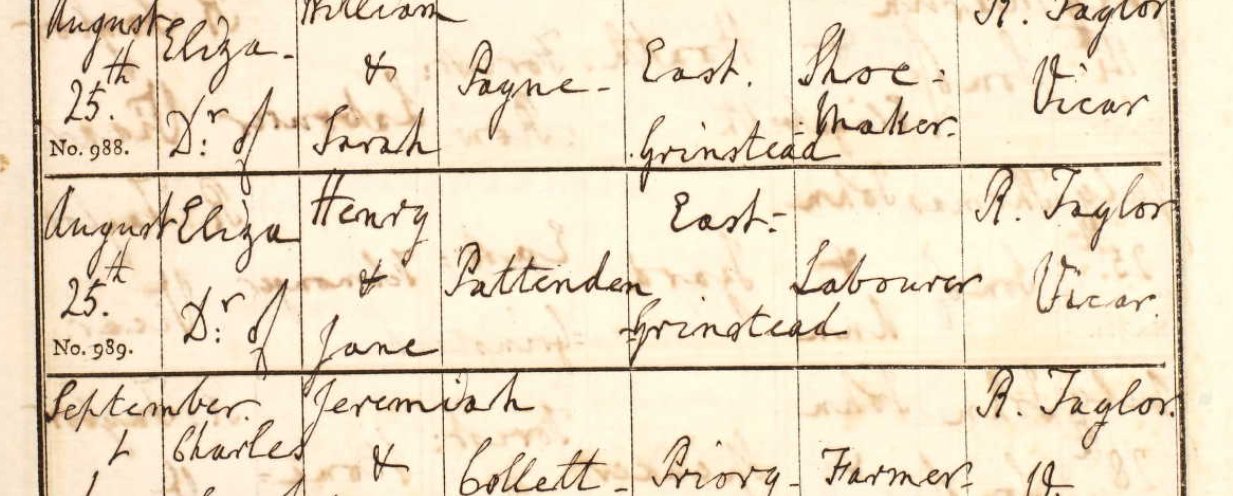
The Pattenden name is unusual among locational surnames in that it remained almost entirely concentrated within the area of its origin for three centuries after first documentation. While many families of comparable standing dispersed widely through the Tudor and Stuart periods, the Pattendens circulated within a tight circuit of parishes: East Peckham, Tonbridge, Speldhurst, Brenchley, Goudhurst, Cranbrook, Hawkhurst, Ticehurst, Wadhurst, Withyham, and the western Sussex parishes around Horsham, East Grinstead, and Worth.
This geographic concentration is both a challenge and a gift to the genealogist. A challenge, because there are so many Pattendens in any given register that untangling them requires systematic work across multiple parishes simultaneously. A gift, because the concentration means the documentary record is extraordinarily rich: wills proved at the Prerogative Court of Canterbury and the Archdeaconry of Canterbury, manorial records, Quarter Sessions papers, hearth tax assessments, and the dense network of parish registers across the Weald all contain Pattenden entries in abundance.
In my own maternal tree, the Pattenden name appears 116 times — by far the most numerous surname in a file of 1,562 individuals. That figure reflects both the natural size of the extended family and the way Pattenden lines intermarried repeatedly across the generations, creating a genealogical web in which a single individual can appear as a collateral relation through three or four different routes simultaneously.
The Pattenden Name Through the Centuries
-
1254First documentary occurrence de Patinden in the Kent Assizes; William and Cecilia de Patinden in Middleton, Kent, 1318.
-
1334Kent Lay Subsidy Ralph and Isolda de Patindenne assessed at nine shillings and sixpence — placing the family in the prosperous yeoman tier of Wealden society.
-
1396Cranbrook Nicholas Patynden — the family spreading into the central Weald cloth-making parishes.
-
1464First modern spelling Bartholomew Pattenden of Staplehurst — the name in the form it has held for 560 years.
-
1470Pattyndenne Manor built, Goudhurst Still standing today as a private family home — a 555-year continuity between name and place.
-
c.1564Henry Pattenden, East Peckham Earliest documented Pattenden in the Medway valley branch; a Henry Pattenden at Oxford, 1582–83.
-
19th–20th c.Dispersal Railways carry descendants into London, Surrey, Sussex — and eventually to Australia, Canada, New Zealand, South Africa, and the United States. The Guild's one-name study holds 10,500 individual records.
Reading the Records
For anyone researching a Pattenden ancestor, the key archives are predictable but deep. The Kent History Centre in Maidstone holds parish registers for the majority of the Kentish Pattenden parishes from the mid-sixteenth century onward, together with the diocesan and archdeaconry probate records that often illuminate family relationships in ways baptism registers alone cannot. The East Sussex Record Office at Lewes covers the Sussex parishes — Ticehurst, Wadhurst, Withyham, Fletching, Maresfield, Worth — and the wills proved at the Archdeaconry of Lewes are particularly valuable for the seventeenth and early eighteenth century dispersal.
The principal challenge in Pattenden research is the repetition of given names. The family had a strong tradition of naming children after grandparents and godparents, which means that across any twenty-year period in the seventeenth or eighteenth century there are typically multiple men named John Pattenden, William Pattenden, or Thomas Pattenden active in the same cluster of parishes. Cross-referencing wills and marriage records is essential to establish which John is which — and reading the original documents, rather than relying on transcriptions alone, often makes the critical difference.
The Guild of One-Name Studies holds a Pattenden One-Name Study maintained by Karen Tayler since 1983, with a complementary DNA project at FamilyTreeDNA. Both are genuinely useful for breaking through the repeated-name problem inherent in Wealden research, and the Guild's combined marriage index provides a check on paper genealogy that cannot otherwise be replicated.
Key Resources for Pattenden Research
Guild of One-Name Studies — Pattenden Study: one-name.org/name_profile/pattenden — the primary repository for Pattenden research worldwide, with 10,500 individual records accumulated since 1983. Contact: Mrs Karen Tayler.
DNA project: familytreedna.com/groups/pattenden — essential for resolving the repeated-name problem inherent in Wealden research.
Kent History Centre, Maidstone: parish registers, wills, and manorial records for the Kentish heartland parishes from the mid-sixteenth century.
East Sussex Record Office, Lewes: Sussex dispersal parishes from the seventeenth century onward; archdeaconry probate series.
Pattyndenne Manor, Goudhurst: the ancestral seat, built 1470, still standing — the physical origin of the name.
A Name Worth Knowing
The Pattendens are not a glamorous family in the aristocratic sense — you will not find them in the Dictionary of National Biography, nor did they accumulate titles or great estates. What they did accumulate, across seven and a half centuries, is an extraordinarily dense documentary record in the archives of England's most archive-rich region. They were yeomen and small farmers, clothworkers and tradesmen, the backbone of the Wealden communities that produced England's iron and cloth and timber through the Tudor and Stuart centuries. Their story is, in many ways, the story of rural England itself.
For any researcher who encounters a Pattenden in their tree — whether as a direct ancestor or a collateral connection through marriage — the name is a doorway into one of the best-documented surname communities in English genealogy. The combination of a concentrated geographic distribution, rich archival survival, an active one-name study, and a DNA project makes Pattenden research unusually tractable, even deep into the seventeenth century. With patience, the right archives, and careful attention to the original documents, the Wealden roots of this name are genuinely within reach.
Do You Have Pattenden Ancestors?
Kentish parish registers are among the richest in England — and among the most demanding to read. If you have Pattenden lines in your family tree and need help with the original documents, Heritage Script can help.
Request Your Consultation