Ancestor Stories · Family History · London · February 2026
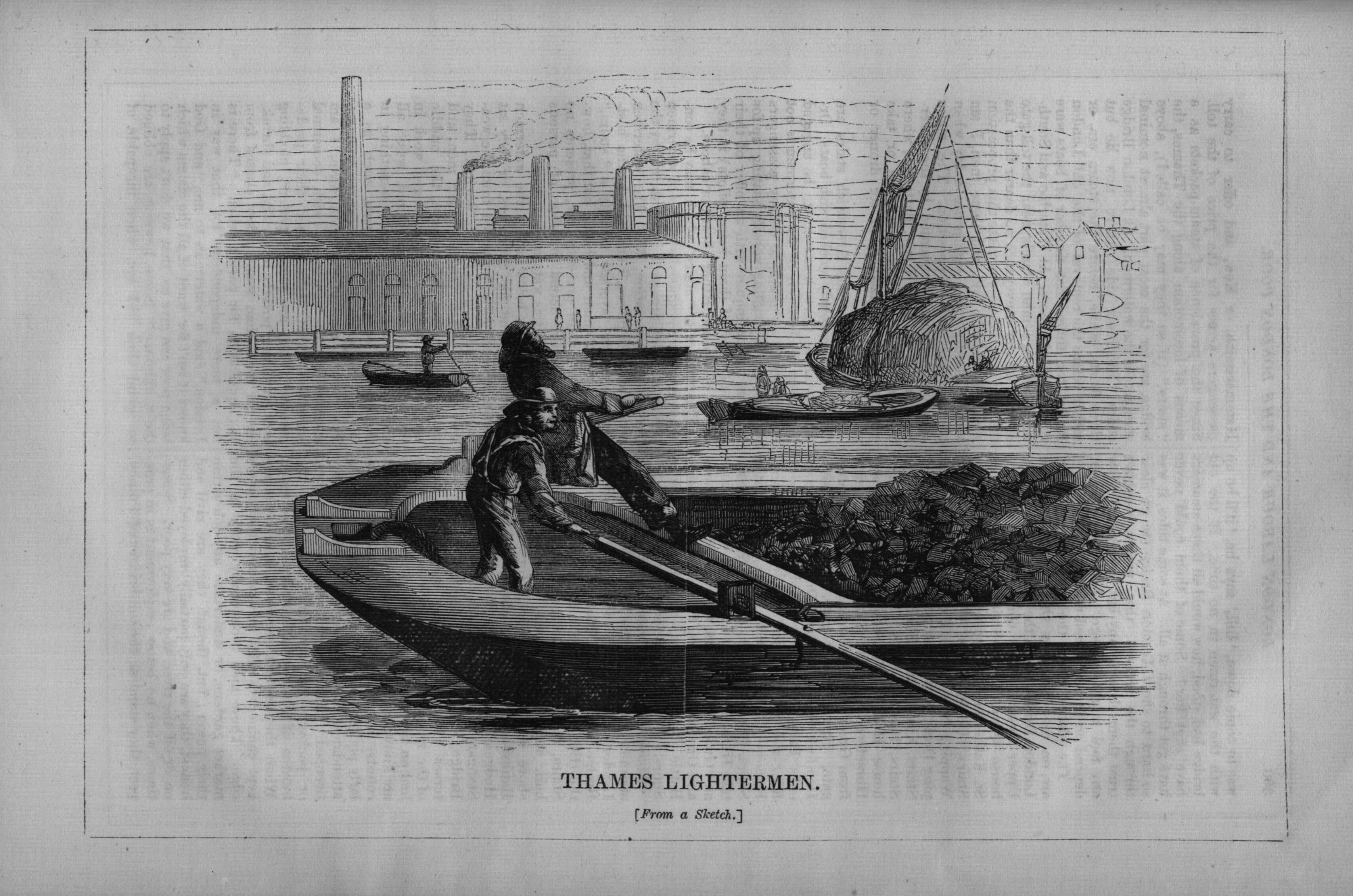
Thames Lightermen — from a sketch, 19th century. Two men work a coal-laden lighter against a backdrop of the industrial south bank: the world the Pealing family almost certainly inhabited for four generations
There is a particular kind of family history that leaves few traces in the grand archives. It is written instead in the grain of a working life — in the knowledge of tides and currents, in three generations born within the same riverside parish, in the address of a death recorded in the shadow of London Bridge. The Pealings of Rotherhithe were such a family.
The GEDCOM data for this family is modest but coherent. Four generations, tightly clustered on the south bank of the Thames, spanning roughly a century from the mid-eighteenth century to the close of the Victorian era.
John Pealing (born 1754, London)
↓
John Pealing (born 1778, Rotherhithe)
↓
Joshua Pealing (born 11 Sep 1814, Rotherhithe; died 4 May 1884, St Olave Southwark)
↓
Mary Ann Pealing (born c.1858, Lambeth; died 1943, Tottenham)
The first John is simply "London" in 1754 — that broad anonymity of a city too vast to pin down. But his son's birth in 1778 is specifically Rotherhithe. That geographic tightening, from the general to the particular, is rarely accidental. Families that worked the river gravitated to it and stayed. By the time Joshua was born on 11 September 1814, the family had been Rotherhithe people for at least one generation; by the time he died there seventy years later, they had been there for three.
John junior married Mary Chamberlain of Bermondsey — another riverside parish immediately to the west — and their union produced Joshua, who in turn became the father of Mary Ann, born around 1858 in Lambeth. It is Mary Ann who eventually carried the Pealing blood northward, marrying James Thomas Camp of St Pancras and dying in Tottenham in 1943: a long arc from the waterman's world to the suburbs, across nearly a century.
To understand the Pealings, one must first understand their parish. Rotherhithe in the eighteenth century occupied a long loop of the Thames on the Surrey bank, immediately downstream from London Bridge — reachable by ferry or by road through the Borough, and in character quite unlike the city it served. Its streets ran close to the water. Its men went to sea, or stayed on the river. Its women waited.
The Howland Great Wet Dock — later Greenland Dock — had opened in Rotherhithe in 1700, the largest commercial dock in England, and with it came the trade that shaped the neighbourhood for a century: the Greenland whale fishery. Ships fitted out at Rotherhithe for voyages to the Arctic. The smell of boiling blubber was, by contemporary accounts, extraordinary. But beyond the whale trade there was the river itself — and the men who made their living on it.
By the early eighteenth century, the Thames between Gravesend and Windsor was regulated by the Company of Watermen and Lightermen, founded by Act of Parliament in 1514 at the command of Henry VIII. Every man who wished to carry passengers by wherry or move cargo by lighter had to be a member of the Company — his apprenticeship duly recorded at Watermen's Hall.
Watermen carried passengers across and along the river in rowing boats called wherries; lightermen worked the cargo, unloading ships into flat-bottomed barges and ferrying goods between vessel and quayside. The two trades merged under one company in 1700, though the men remained quite distinct in character and circumstance: a lighterman who owned his own barge could be a man of reasonable means, while the wherry-man scraping a living from river fares was often poor and precarious.
Both trades were hereditary almost by instinct. The Company's own records note it plainly: fathers apprenticed sons, brothers apprenticed brothers, husbands apprenticed in-laws. A boy born in Rotherhithe in the eighteenth century, to a father who worked the river, would in all probability follow him onto it.
For the family historian, the watermen's trade left an unusually rich documentary record. The Company of Watermen and Lightermen was meticulous in its administration, and the records it generated survive in remarkable completeness.
The Binding Books, 1688–1908 (MS 6289, Guildhall Library), record each apprentice's name, birthplace, the name of his master, and the date he gained his freedom. Coverage begins within living memory of the Pealings' first confirmed generation.
The Apprenticeship Affidavit Books, 1759–1897 (MS 6291), were filed by date of binding and record the date and place of the apprentice's baptism — potentially the most valuable source for extending a family line.
The Quarterage Files, 1764–1917, note each member's quarterly dues payments and the location where they worked — placing a man on a specific stretch of the river, at a specific plying place, in a specific year.
All of this is now indexed on Findmypast under Thames Watermen & Lightermen 1688–2010. A search for the name Pealing — uncommon enough to produce a manageable result set, specific enough to be distinctive — would take minutes and could confirm or rule out the family's presence in the trade at a stroke. If they are there, the Affidavit Books would give baptism details for any apprentice, potentially pushing the line back before John senior's 1754 birth. The Quarterage Files would place them on a named stretch of the river.
Research Note — Watermen's Hall
The Company of Watermen and Lightermen at Watermen's Hall, 16–18 St Mary-at-Hill, London EC3R 8EF, offers a genealogical research service for a modest fee (currently £20 for a single-surname enquiry). They will search the binding books on your behalf and report any matches found. For a family with the Pealings' geography and chronology, this is among the most likely archives to produce a positive result — and the most direct route to confirming whether the waterman connection is documented fact or informed inference.
There is also the matter of the Doggett's Coat and Badge Race — the oldest continuously run sporting event in the world, rowed annually since 1715 from London Bridge to Chelsea by six young watermen freshly freed from their apprenticeships. Every competitor, including those who were drawn by lot but did not win, is indexed. If a Pealing ever rowed for the coat and badge, his name is there still, waiting to be found.
Joshua Pealing's lifetime on the river coincided with its most turbulent transformation. When he was born in 1814, the Thames was London's main thoroughfare: bridges were few, omnibuses nonexistent, and the waterman's wherry was as necessary for crossing the river as it had been in Tudor times. By the time he died in 1884, the world had changed almost beyond recognition.
London Bridge had been rebuilt and widened. Waterloo Bridge opened in 1817. Hungerford, Lambeth, and others followed. Each new crossing took trade from the watermen, who had earned their living ferrying passengers who could now walk. Steamboats appeared on the Thames in the 1820s, further eroding the market for the traditional wherry. And then, decisively, came the railways — the London and Greenwich line running along the south bank from 1836, followed in rapid succession by connections that made it possible to traverse all London without setting foot on a boat.
By 1850, it was estimated that no more than 1,500 watermen remained working from fewer than eighty plying places on the whole of the tidal Thames — a fraction of the community that had once dominated the river. Those who could adapt did: some became customs officers, some joined the Thames Fire Brigade. Others simply left the water.
Joshua outlasted the golden age of the waterman by several decades. That he died at St Olave Southwark in 1884 is quietly eloquent: St Olave's was the riverside church of the south bank working community, the watermen's church, the sailors' church — the church of men who had spent their lives in sight of the Thames. Whether Joshua was among them in profession as well as geography, the records at Watermen's Hall may yet confirm.
His daughter Mary Ann's birth around 1858 in Lambeth — the first generation born away from Rotherhithe itself — marks the beginning of the family's long drift away from the river. She married James Thomas Camp, a St Pancras man, and died in Tottenham in 1943. The Pealings' century on the Thames was over.
Even without occupational confirmation, the pattern of where the Pealings lived and died is itself evidence of a kind. This was not a family drifting through London — it was a family anchored, generation after generation, to a specific few streets on the south bank of the Thames.
Rotherhithe was not a place one happened to be from. It was a community with a clear economic identity: the river. The men who lived there in the eighteenth and early nineteenth centuries were overwhelmingly engaged in maritime trades — as sailors, shipwrights, ropemakers, or watermen. A family in Rotherhithe in 1778, producing a son who lived and died there and whose own death was recorded at the watermen's church, is almost certainly a river family. The inference is strong even in the absence of documentary proof.
Documentary proof is nevertheless attainable. The Findmypast index, Watermen's Hall, the London Metropolitan Archives, and the Rotherhithe parish registers at the London Metropolitan Archives together represent a set of sources capable of resolving the question definitively. The Pealing family line is, in genealogical terms, a short archive visit away from confirmation.
Findmypast — Thames Watermen & Lightermen 1688–2010. Search "Pealing" in the Apprentice Bindings. Quick, inexpensive, potentially definitive.
Watermen's Hall — postal or email enquiry, currently £20 per surname. The Company will search the binding books and report any matches directly.
London Metropolitan Archives — the Rotherhithe registers are well-preserved and cover the period of the Pealings' residence in the parish comprehensively.
London Metropolitan Archives — Joshua's death record. The burial register may note his occupation; churchwardens' accounts may provide additional context about this riverside community.
The Pealings are representative of a category of ancestor that many researchers find the most elusive: the working family without a trade recorded in the documents that survive most easily. Wills, deeds, and court records — the great troves of genealogical material — tend to capture property-owners and those who came into legal conflict. A waterman who paid his dues at Watermen's Hall, raised his children in Rotherhithe, and died at St Olave without ever owning land or disputing a boundary left almost no trace in the conventional archive.
This is why the occupational records kept by the livery companies and trade guilds are so important. The watermen's bindings do not discriminate by wealth or property: they record every apprentice who entered the trade, from the son of the most prosperous lighterman to the boy of the poorest wherry-man. They are, in a sense, the democratic archive — the record of working life that the other sources rarely provide.
The Pealings were not famous. They did not appear in histories of the age. But they were there, on the Thames, in the years when it was still the beating heart of the greatest city in the world — and that is a history worth recovering.
What documents like the Stanford will — the subject of an earlier Journal entry — do for the propertied classes, the watermen's bindings do for the men who worked the river. They recover names, relationships, and specific places in time. They give us, in short, the ancestors who would otherwise be lost in the broad generality of "London."
The Pealings of Rotherhithe deserve to be found. The records, in all probability, are waiting for them.
No written account of the waterman's world quite matches hearing it in their own voices. This documentary gathers the oral histories of Thames lightermen — men who served their seven-year apprenticeships at Watermen's Hall, worked the hereditary trade from father to son, and watched the river trade they loved disappear within a single generation. The apprenticeship records, the bindings, the quarterage dues, Greenland Dock, Rotherhithe, Bermondsey: everything described in this article, alive in living memory.
Thames Lightermen — oral history documentary. Archival footage and personal accounts of the waterman's life, the apprenticeship at Watermen's Hall, and the slow decline of a trade that defined the south bank for three centuries.
If you have ancestors who lived in Rotherhithe, Bermondsey, Wapping, Limehouse, or any of the Thames-side parishes of London, there is a good chance the watermen's records hold something for you. The combination of parish registers, occupational bindings, and the Quarterage Files makes the riverside community one of the best-documented working populations in British genealogy.
If you have a document connected to this world that you cannot read — a will, a settlement examination, a parish register entry in difficult hand — I would be glad to help you unlock it.
Get in TouchA Note on Sources
The family data in this article derives from a client GEDCOM file containing 134 individuals. The Pealing family line as presented represents the documentary record as it currently stands; the waterman connection is an informed inference based on geography, chronology, and community context, not yet confirmed by occupational records. The records of the Company of Watermen and Lightermen are held at the Guildhall Library (MS 6289, MS 6291) and indexed at Findmypast.co.uk under Thames Watermen & Lightermen 1688–2010. Watermen's Hall, 16–18 St Mary-at-Hill, London EC3R 8EF, offers a postal and email research service. The London Metropolitan Archives holds the Rotherhithe parish registers and the records of the River Fencibles (CLC/057). Henry Mayhew's London Labour and the London Poor (1861) contains contemporary accounts of watermen's working lives.
Filed under: Family History London Working Lives Watermen 19th Century
Send me your historical document for a free sample transcription and no-obligation consultation.
Request Your Consultation