Ancestor Stories · Women's History · 1920s Britain · April 2026
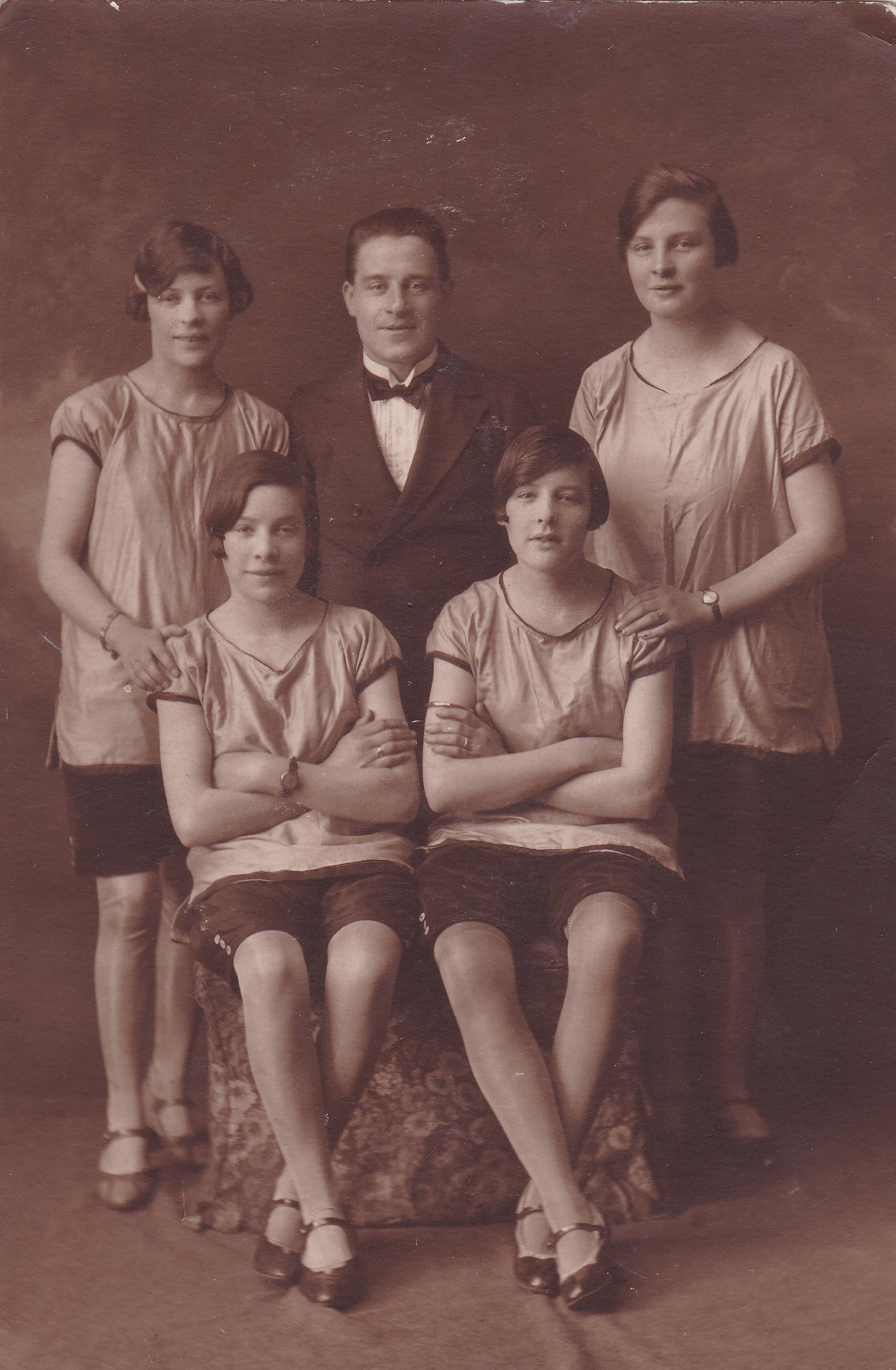
The Wheeler sisters with Leonard Camp, c.1924–1926. Seated in front are the twins: Dorothy ('Fairy', fair-haired) and Gladys ('Darkie', dark-haired). A professional studio portrait in matching satin performance costumes with velvet trim — the hallmark of a troupe that took itself seriously.
History has a particular weakness for the famous flapper. She appears in the memoirs of Evelyn Waugh and the photographs of Cecil Beaton: bobbed hair, cigarette holder, cocktail in hand, dancing at a house party in Mayfair. She is real, and she is marvellous. But she is not the whole story. For every Bright Young Thing whose name made the gossip columns, there were hundreds of young women in Tottenham and Edmonton and Wood Green who bobbed their hair, shortened their skirts, and danced — not in grand houses, but in church halls and working men's institutes and assembly rooms across the suburbs of London. The Wheeler sisters were four of them.
The Wheeler family were North London people. Albert John Wheeler, born in Islington in October 1872, raised his family in the adjacent parishes of Wood Green and Edmonton — suburban streets of terraced housing expanding rapidly outward from the city in the years before the First World War. It was into this world that his children arrived, one by one, in the first decade of the twentieth century.
Ruby Louise Wheeler born 30 January 1906, Wood Green, Middlesex
·
Constance May Wheeler born 3 January 1909, Edmonton, London
·
Gladys Wheeler born c.1910, Wood Green, Middlesex — known as 'Darkie'
·
Dorothy May Wheeler born 27 February 1911, Edmonton, Middlesex — known as 'Fairy'
with Leonard Camp, born 22 November 1900, St Pancras, London
Four daughters born within five years — Ruby the eldest, then Constance, then Gladys and Dorothy arriving in quick succession, close enough in age that they were almost certainly the twins of family memory. Their brother Robert arrived in 1904, but it is the sisters who concern us here: four young women who came of age in the decade after the Great War and who, in the photograph that survives them, look entirely ready for it.
When the photograph was taken — almost certainly in the mid-1920s, judging by the costumes and the hairstyles — Ruby was perhaps nineteen, Constance sixteen, and the two younger girls in their early teens. They are wearing matching satin performance blouses in a pale colour, with dark velvet trim at the hems and sleeves, and T-bar dance shoes. Their hair is cropped in the close, side-parted style that was new and modern and slightly daring. They have been to a professional photographer's studio. They have dressed as a troupe.
At the centre of the group stands Leonard Camp, born in St Pancras in November 1900 — six years older than Ruby, nine years older than Constance, the young man who would eventually marry Constance and become the grandfather to whom this photograph was passed down. He is in a dark dinner jacket and bow tie, the formal dress of a musician or a master of ceremonies, and he looks entirely comfortable there, flanked by the four sisters with the easy confidence of a man who knows his place in an arrangement.
To understand what the Wheeler sisters were doing, one must understand the world they inhabited. The 1920s concert party — amateur or semi-professional, usually local in its audience and intimate in its scale — was one of the great social institutions of interwar Britain, and it has been almost entirely forgotten.
It had its origins in the Victorian pierrot troupes of the seaside, themselves descended from the travelling players of the fairground, and by the 1920s it had spread inland, into the suburbs, into the church hall and the working men's club and the institute reading room. A concert party might perform a selection of popular songs, a dance number or two, a comic sketch, and a patriotic finale — the whole thing running for an hour or ninety minutes, with a pianist in the corner keeping everything moving. Entry was usually sixpence or a shilling. The proceeds went to the church roof fund, or the hospital, or the returning soldiers' welfare committee.
For the young women who performed in these troupes, the concert party offered something that polite Edwardian society had not quite allowed: the freedom to appear on a stage, in a short skirt, and be applauded for it. It was respectable entertainment, organised within the community, sanctioned by the vicar or the club committee. And within that respectable frame, it was quietly revolutionary.
The costumes in the Wheeler sisters' photograph are entirely characteristic of this world. Matching outfits were standard for a dance troupe, both for visual effect and to signal organisation and professionalism. The dropped-waist satin blouse with dark velvet trim was fashionable and modern — it echoed the silhouette of the stage costumes being worn by the era's professional performers — but it was not scandalous. It was, precisely, the costume of a girl who knew what was done. The T-bar shoes, low-heeled and strapped, were perfect for dancing. Every detail of the image is purposeful.
That they had their portrait taken in a professional studio tells us something important. This was not a casual afternoon's entertainment captured on a box Brownie. Studio portraits cost money. You booked an appointment, you arrived in your performance clothes, you arranged yourselves as a group. You were, in the language of the age, putting on a show — and you wanted a record of it. The Wheeler sisters were not dabbling. They were proud of what they did.
Leonard Camp was born in St Pancras on 22 November 1900, the son of James Thomas Camp, whose family had drifted northward from Essex over the previous two generations. He is described in family memory as a pianist — the accompanist for the sisters' act — and what is remembered most clearly about his playing is that he was never formally trained. He played entirely by ear.
This was not unusual in the concert party world, and in some respects it was an advantage. A pianist who could read music was useful; a pianist who could pick up any tune by instinct, who could vamp an accompaniment the moment he heard the melody, who could follow a singer through an unexpected key change without losing a bar — that was something rarer and more valuable. The working musicians of the pub and the music hall, the club pianists and the silent film accompanists, were overwhelmingly self-taught. Formal training was for the concert hall. The popular entertainer learned by listening.
The popular songs of the 1920s were made for the ear rather than the page. The Charleston, the Black Bottom, the foxtrot — these were rhythms absorbed from gramophone records and danced to in front rooms and village halls, not learned from printed scores. Leonard Camp's gift was precisely the gift the age required.
By the time the photograph was taken he was in his mid-twenties and the sisters ranged from their early teens to perhaps nineteen. That a young man of twenty-four would spend his Saturday evenings playing piano for four sisters who danced is, in itself, quietly telling. He is entirely comfortable in the image — centre stage, at ease, the natural pivot of the group. Courtships in the concert party world often began this way: the musician and the performer, bound together by the act they created, drifting naturally from professional affection to something more lasting.
Constance May Wheeler married Leonard Camp and together they appear in the family record as the grandparents through whom this photograph was preserved. Without them — without that marriage, without Constance keeping the portrait through the decades that followed — the Wheeler sisters would have been entirely lost. There would be names in a register, four girls born in Edmonton and Wood Green in the years before the war, and no more.
Wood Green and Edmonton in the 1920s were places of a very particular kind: inner suburb turning outer suburb, the new terraced streets of the Edwardian expansion now filling with families, the tram routes pushing further north, the cinema arriving on the high street, the dance hall opening above the pub. They were not fashionable — they were never fashionable — but they were alive with the particular energy of young working people who had survived the war and were determined, in whatever way their means allowed, to enjoy what came after it.
The flapper as she appears in history books is a figure of the West End: the girl who danced at the Hammersmith Palais, who went to parties in Chelsea, whose photograph appeared in the Tatler. But the spirit she embodied — the shorter skirt, the bobbed hair, the insistence on pleasure and movement and a kind of bodily freedom that the Victorian era had denied — was not confined to those who could afford the Hammersmith Palais. It found its way to Wood Green too.
All four sisters wear the close-cropped, side-parted bob that was the decade's defining statement. It required a barber or a skilled friend and a certain nerve — in 1924 it was still new enough to be remarked upon.
Matching satin blouses with velvet-trimmed hems and sleeves, T-bar dance shoes. Someone — a mother, perhaps, or a dressmaker — made four identical outfits. This was an investment, and a commitment.
A professional studio sitting cost money and required organisation. The decision to commission it tells us the sisters understood themselves as performers. They wanted a record of what they had made.
It is worth pausing on what we do not know. We do not know what the sisters called their troupe, or whether it had a name at all. We do not know which halls they performed in, or whether they were paid or simply applauded. We do not know what they danced — the Charleston, certainly, was the dance of the moment; the foxtrot was everywhere — or what songs Leonard played for them. The family memory preserves only the outline: four sisters, a troupe, a pianist who played by ear.
That outline is, in its way, complete. The photograph fills in what the words leave bare.
The Wheeler sisters left almost no trace in the public record. Their births are registered; Constance's marriage to Leonard is recorded; their deaths, eventually, noted. But the Saturday evenings spent performing, the rehearsals in the front room, the sewing of the matching costumes, the applause — none of this left a mark in any archive that survives. Women's social and cultural lives, especially the lives of working women without property or public standing, evaporated from the record as a matter of course.
This is not an accident of preservation. It is a structural feature of the archives we have inherited. The records that survive in greatest abundance are those generated by legal and financial transactions: wills, deeds, court documents, rate books, electoral registers. Women who did not own property, who did not appear in court, who did not vote (until 1928, and then only if they were over thirty), generated few such documents. They are present in the census — a head count, an age, an occupation if they had one — and in the parish register, and almost nowhere else.
The photograph the Wheeler sisters had taken in a professional studio is, therefore, not merely a charming family keepsake. It is a document. It records something that no official source would ever have captured: four young women, in the act of being exactly who they chose to be.
For the family historian, this gap presents both a challenge and an invitation. The challenge is clear: without documentary evidence, we cannot reconstruct the details of the sisters' performing lives. We cannot say with certainty where they appeared, how long the troupe lasted, or what became of the act as the sisters grew older and their lives diverged. Constance married Leonard and the record follows her. Ruby, Gladys, and Dorothy are known only in outline.
The invitation is to look at what survives differently. The photograph, the family memory, the pattern of births and locations in the GEDCOM — these are evidence, even if they are not the evidence the formal archive provides. They place four sisters in Wood Green and Edmonton in the 1920s, organising themselves into a performing troupe, having their portrait taken in costume, living the decade with a spirit that the gossip columns never reached and the archives never caught.
Research Note — Tracing the Concert Party World
Local newspapers are the most likely source of surviving evidence for amateur concert parties of this period. The Wood Green and Tottenham Weekly Herald, the Edmonton Weekly Herald, and similar local titles frequently carried announcements and brief reviews of parish concerts, institute entertainments, and charity performances. The British Newspaper Archive at britishnewspaperarchive.co.uk holds a substantial collection of North London local press for the 1920s, searchable by keyword. A search for the Wheeler surname, or for the names of Edmonton and Wood Green churches and institutes, might surface a programme listing or a brief notice. The British Library's newspaper collection at Colindale (now held at Boston Spa) is the longer route to the same material.
There is a temptation, in writing about working women of the 1920s, to cast them as passive recipients of history — buffeted by the war, liberated by the vote, transformed by the economy. The Wheeler sisters resist this framing. They were active. They organised. They rehearsed. They had costumes made and a pianist engaged and a photographer booked. Whatever they were performing, they were performing it deliberately, with skill and commitment and a clear sense of how they wished to present themselves to the world.
Ruby would have been the eldest and probably the leader — the girl who remembered what steps came next, who negotiated with the hall committee, who kept the younger ones in line. Dorothy and Gladys, arriving within a year of each other, were the twins at the heart of the act — and they performed under the nicknames their colouring had earned them. Dorothy, fair-haired, was known as Fairy; Gladys, dark-haired, as Darkie. These were stage names in the truest sense: simple, memorable, built around contrast. Two sisters, light and dark, mirror images in movement if not in appearance — it is easy to imagine how they were presented, their twinness made theatrical, playing to an audience who would have delighted in it. And Constance, the second-born, somewhere between the two: the one who kept the photograph, who married the pianist, who carried the story forward into the next generation.
We cannot recover the applause. We cannot know whether they were nervous or exhilarated or both. We cannot hear the tune that Leonard played, or feel the particular pleasure of a performance going well in a warm room full of neighbours. But the photograph gives us something that no archive quite matches: the four of them, in costume, together, looking directly at the camera with the calm confidence of young women who know exactly what they are about.
The flappers the gossip columns wrote about are well remembered. The Wheeler sisters of Edmonton and Wood Green are not. But they were there — dancing, in matching satin, to a tune their accompanist knew by heart. That is a history worth keeping.
The women in your family tree who left the fewest documents often have the most compelling stories — stories that survive, if at all, in photographs, in family memory, and in the local newspapers that recorded the texture of everyday life. If you have a document connected to those lives that you cannot read — a will, a letter, a settlement record in difficult hand — I would be glad to help you unlock it.
Get in TouchA Note on Sources
The family data in this article derives from a personal GEDCOM file. The Wheeler family records — births, marriage, and deaths — are drawn from GRO index entries and census material. The professional portrait illustrated is a family photograph, held privately. Details of the concert party tradition of the 1920s draw on Michael R. Booth, Theatre in the Victorian Age (Cambridge, 1991); Len Platt, Musical Comedy on the West End Stage, 1890–1939 (Palgrave Macmillan, 2004); and contemporary accounts in the British Newspaper Archive. North London local press for the 1920s is searchable at britishnewspaperarchive.co.uk. The British Library newspaper collection (now at Boston Spa, Yorkshire) holds the fuller run of Edmonton and Wood Green titles.
Filed under: Women's History 1920s Britain Family History London Interwar Concert Party
Send me your historical document for a free sample transcription and no-obligation consultation.
Request Your Consultation