Sample Transcriptions
Here are examples of the types of documents I work with. Each shows the level of accuracy and attention to detail you can expect.
18th Century Will - James Stanford (1749)
Original Document (Pages 1 & 2)
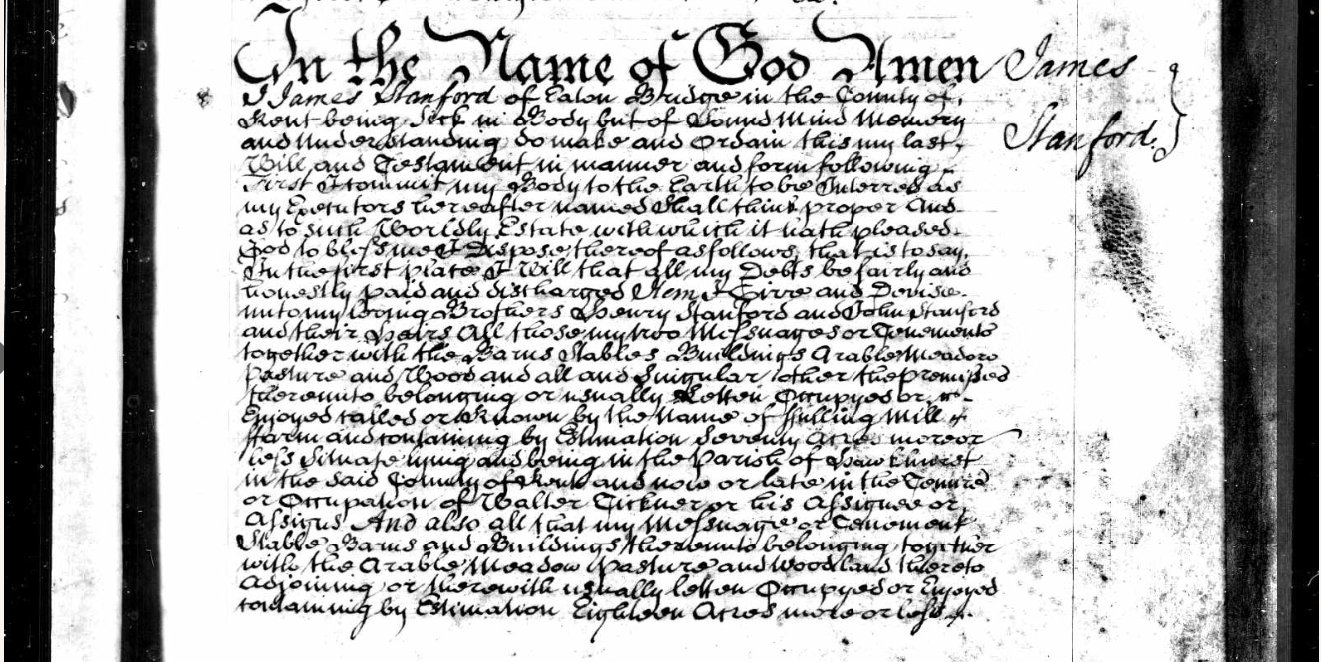
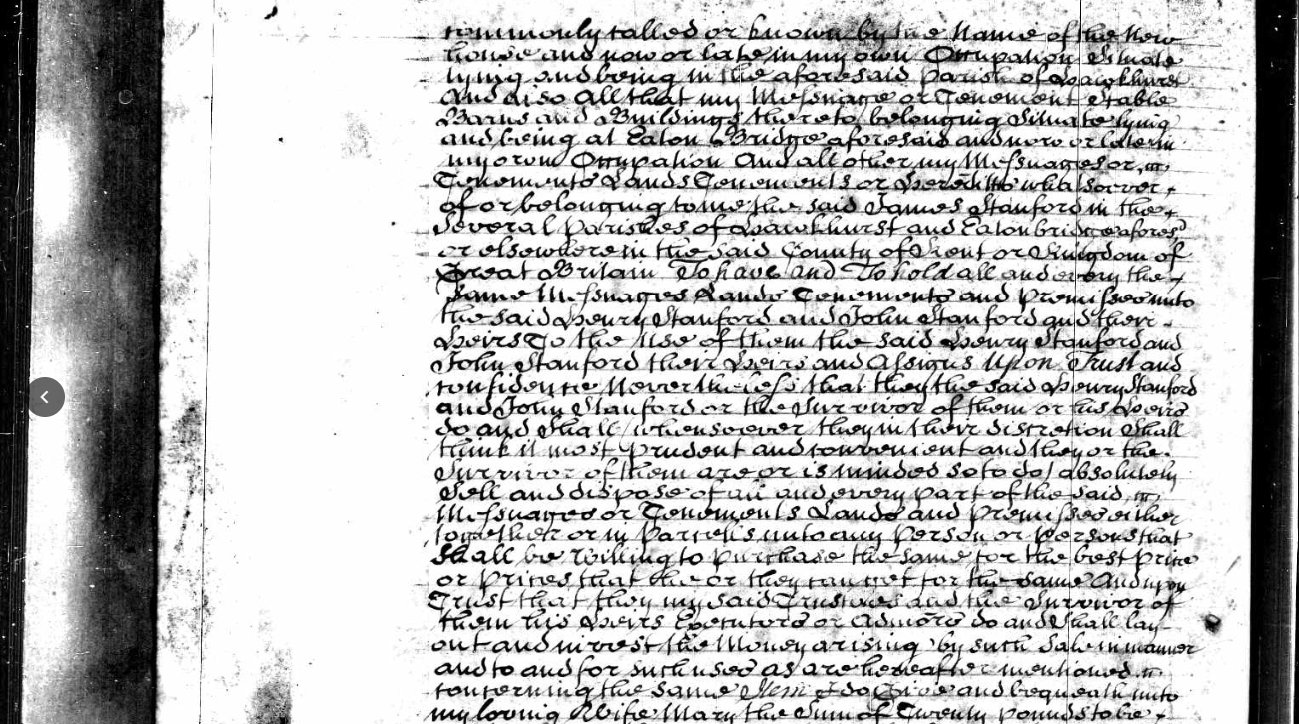
18th century secretary hand - click images to enlarge
Transcription (Pages 1 & 2 - Extract)
Page 1
1. In the Name of God Amen
2. I James Stanford of Eaton Bridge in the County of
3. Kent being Sick in Body but of Sound Mind Memory
4. and Understanding do make and Ordain this my last
5. Will and Testament in manner and form following
6. First I commit my Body to the Earth to be Interred as
7. my Executors hereafter named shall think proper and
8. as to such Worldly Estate with which it hath pleased
9. God to bless me I dispose thereof as follows that is to say
10. In the first place I Will that all my Debts be fairly and
11. honestly paid and discharged Item I Give and Devise
12. unto my loving Brothers Henry Stanford and John Stanford
13. and their Heirs All those my two Messuages or Tenements
14. together with the Barns Stables Buildings Arable Meadow
15. Pasture and Wood and all and Singular other the premises
16. thereunto belonging or usually letten Occupyed or
17. Enjoyed called or known by the Name of Fulling Mill
18. Farm and containing by Estimation Seventy Acres more or
19. less Situate lying and being in the Parish of Hawkhurst
20. in the said County of Kent and now or late in the Tenure
21. or Occupation of Walter [unclear] or his Assignee or assignees
22. And also all that my Messuage or Tenement Stable Barns and
23. [unclear]Buildings thereunto belonging together with the Arable
24. Meadow Pasture and Woodlands thereto adjoining or therewith
25. usually letten occupied or Enjoyed containing by Estimation
26. Eighteen Acres more or less commonly called or known by the
27. Name of the New House and now or late in my own Occupation [...]
Page 2
28. And also all that my Messuage or Tenement Stable
29. Barns and [out]Buildings thereto belonging Situate lying
30. and being at Eaton Bridge aforesaid and now or late in my own Occupation
31. And all other my Messuages or Tenements Lands and Tenements
32. and Tenements or Hereditaments whatsoever of or belonging to me the said James Stanford
33. in the several Parishes of Hawkhurst and Eaton Bridge aforesaid
34. or elsewhere in the said County of Kent or Kingdom of
35. Great Britain To have and To hold all and every the
36. same Messuages Lands Tenements and Premises unto
37. the said Henry Stanford and John Stanford and their
38. Heirs To the Use of them the said Henry Stanford and
39. John Stanford their Heirs and Assigns Upon Trust and
40. Confidence Nevertheless that they the said Henry Stanford
41. and John Stanford or the Survivor of them or his Heirs
42. do and shall whensoever they in their discretion shall
43. think it most prudent and convenient and they or the
44. Survivor of them are or is minded so to do absolutely
45. Sell and dispose of all and every part of the said
46. Messuages or Tenements Lands and Premises either
47. together or in Parcels unto any Person or Persons that
48. shall be willing to purchase the same for the best Price
49. or Prices that he or they can get for the same [...]
The full will spans 11 pages. Key bequests include:
• £20 to his wife Mary (immediate payment upon death)
• £28 per annum to his wife Mary for life
• Three substantial properties in Hawkhurst and Edenbridge to his brothers Henry and John Stanford (held in trust)
• Personal estate including household goods and furniture divided between wife and daughters
• Executors: brothers Henry Stanford and John Stanford
Historical Note: James Stanford was a member of the notorious Hawkhurst Gang, known as James 'Trip' Stanford. The Hawkhurst Gang was one of the most infamous smuggling gangs operating in Kent and Sussex during the 18th century. This will provides a rare glimpse into the legitimate property holdings of a gang member — the three properties mentioned (Fulling Mill Farm 70 acres, New House 18 acres, plus Edenbridge property) plus cash bequests suggest Stanford had accumulated considerable wealth. In James Stanford's case, crime clearly paid!
Want to know more? The story behind this will — including the Stanford family's roots in Edenbridge and an unexpected genealogical connection — is told in full in the Heritage Script Journal: The Money Man of the Hawkhurst Gang: What a Will Reveals →
Line numbering: Each line corresponds to the actual line in the original document for easy verification.
Note: Original spelling retained. Any word that cannot be read with confidence is marked [unclear]. Complete transcription available on request.
Elizabethan State Letter — Henry Herbert, 2nd Earl of Pembroke (1589)
The National Archives, C 115/98, fol. 20 · autograph letter with docket of receipt
Original Document
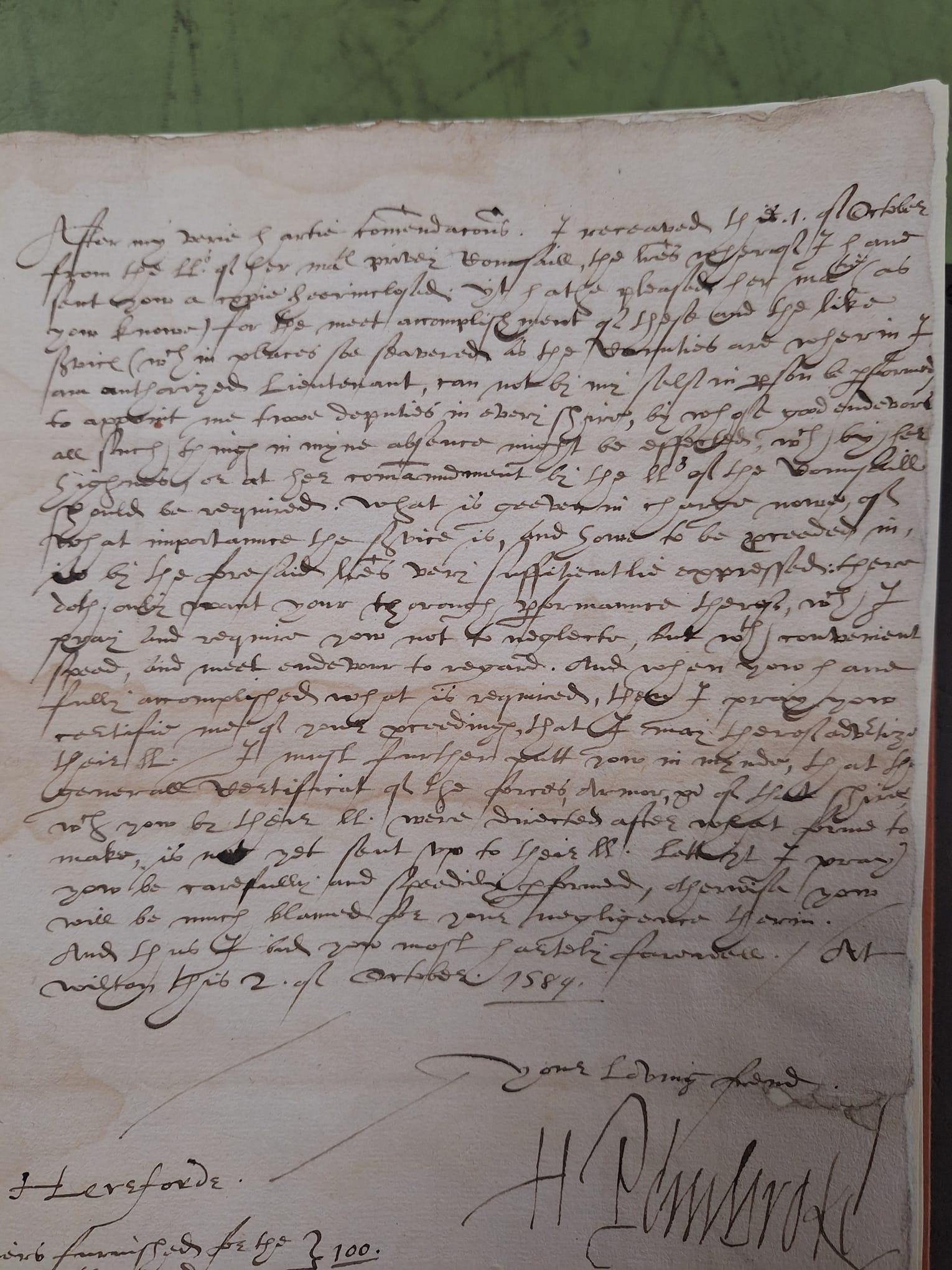
Autograph letter, Wilton, 2 October 1589 — the writer's own secretary hand - click to enlarge
Transcription
1. After my verie hartie comendac[i]ons. I receaved th[e] 1. of October
2. from the ll. of her ma[jes]t[ie]s privey Councell, the l[ett]res wherof I have
3. sent yow a copie heerinclosed: yt hathe pleased her ma[jes]tie (as
4. yow knowe) for the meet accomplishment of theise and the like
5. s[er]vice (w[hi]ch in places soe scattered as the Counties are wherin I
6. am authorized Lieutenant, can not by my self in p[er]son be p[er]formed)
7. to appoint me twoe deputies in every shire, by whose good endevo[u]r
8. all such thinges in myne absence might be effected, w[hi]ch by her
9. highnes, or at her comaundment by the ll[ords] of the Councell
10. should be required. What is geven in charge nowe, of
11. what importaunce the s[er]vice is, and howe to be proceded in,
12. is by the foresaid l[ett]res verie sufficientlie expressed: there
13. doth onely rest yowr thorough performaunce therof, w[hi]ch I
14. pray and require yow not to neglecte, but w[i]th convenient
15. speed, and meet endevo[u]r to regard. And when yow have
16. fully accomplished what is required, then I pray yow
17. certifie mee of yowr proceedinges, that I may therof advertise
18. their ll. I must further putt yow in mynde, that the
19. generall certificat of the forces, Armo[u]r, &c of this shire
20. w[hi]ch yow by their ll. were directed after what forme to
21. make, is not yet sent vp to their ll. Lett yt I pray
22. yow be carefully and speedily p[er]formed, otherwise yow
23. will be much blamed for yowr negligence therin.
24. And thus I bid yow most hartely farewell. At
25. Wilton this 2. of October 1589.
Yowr loving frend.
H Pembroke
Endorsements (lower left, below the signature): "Hereforde" · "Souldiers furnished for the shire in Irelande — 100"
Docket of receipt (foot of leaf, second hand): These l[ett]res were rec[eived] at thandes of Roger Barber one of the messengers at the Court, the vij[th] of October.
Plain-English Reading
I must further put you in mind that the general certificate of the forces and armour of this shire, which you were directed to make, has not yet been sent up. Let it be carefully and speedily done, otherwise you will be much blamed for your negligence in it.
And thus I bid you most heartily farewell. At Wilton, this 2nd of October 1589. Your loving friend, H. Pembroke."
Writer: Henry Herbert, 2nd Earl of Pembroke (c.1538–1601), Lord President of the Council in the Marches, writing from his seat at Wilton
Recipients: His deputy lieutenants for Herefordshire — the leaf is endorsed "Hereforde" and records 100 soldiers furnished for the shire's levy to Ireland
Historical Context: Written five months after the Armada campaign, this letter shows the ordinary administrative machinery of an Elizabethan county lieutenancy in action — a Privy Council directive being relayed down through a regional lieutenant to his local deputies, with a demand for an overdue return of the shire's forces and armour. Delivered five days later, on 7 October, by hand of Roger Barber, one of the messengers of the Court.
Hand: The writer's own English secretary hand, tightly and confidently written, with a second, later hand adding the docket of receipt.
Professional Approach: Every word above has been read with confidence from the original — no guessed or best-guess readings are presented as settled fact. Editorial expansions of contemporary abbreviations are shown in square brackets throughout.
18th Century Transportation Indenture (1730)
Original Document
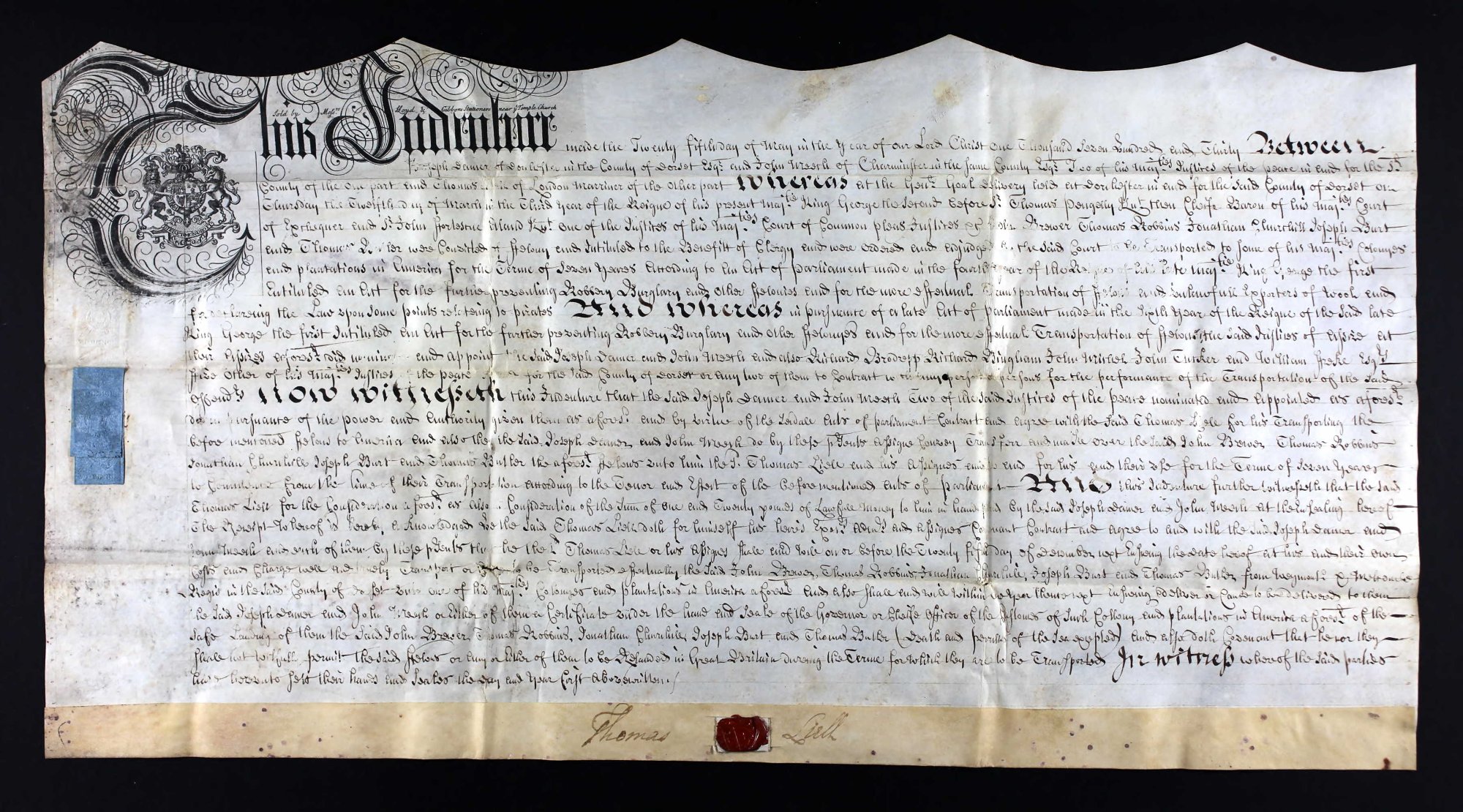
Ornate indenture with blackletter header - click to enlarge
Transcription (Opening Section)
THIS INDENTURE
1. made the Twenty fifth day of May in the Year of our Lord Christ One Thousand seven hundred
2. and Thirty Between Joseph Damer of Dorchester in the County of Dorset Esquire and
3. John Worth of Charminster in the same County Esquire, Two of his Majesty's Justices of the Peace in and
4. for the said County of the one part, and Thomas Lisle of London Mariner of the other part
5. Whereas at the General Goal Delivery held at Dorchester in and for the said County of Dorset on
6. Thursday the Twelfth day of March in the Third year of the Reign of his present Majesty King
7. George the Second before Sir Thomas Pengelly Knight Lord Chief Baron of his Majesty's Court of Exchequer and
8. Sir John Fortescue Aland Knight one of the Justices of his Majesty's Court of Common Pleas, Justices of Oyer and Terminer,
9. John Brewer, Thomas Robbins, Jonathan Churchill, Joseph Burt and Thomas Buller were convicted of felony and entitled
10. to the Benefit of Clergy and were ordered and adjudged by the said Court to be Transported to some of his
11. Majesty's Colonies and Plantations in America for the Term of Seven Years According to an Act of Parliament
12. made in the fourth year of the reign of his late Majesty King George the First intituled An Act for the further
13. preventing Robbery Burglary and other Felonies and for the more effectual Transportation of Felons and unlawful
14. Exporters of Wool and for declaring the Law upon some points relating to Pirates And Whereas [continues...]
Document Type: Criminal Transportation Indenture, dated 25th May 1730
Location: Dorchester, County of Dorset
Historical Context: This indenture orders convicted felons (John Brewer, Thomas Robbins, Jonathan Churchill, Joseph Burt, and Thomas Buller) to be transported to the American colonies for seven years, under the Transportation Act. Archival reference: Q/S/G/2/I, Dorset History Centre.
People Named: Joseph Damer and John Worth, the two Dorset Justices of the Peace who contracted the transportation, are independently identifiable historical figures — Joseph Damer (1676–1737) was MP for Dorchester 1722–1727, and John Worth's family held the Charminster estate. Sir Thomas Pengelly was Lord Chief Baron of the Exchequer until his death in December 1730, and Sir John Fortescue Aland sat as a Justice of Common Pleas at this date — both consistent with the document's own dating. The mariner contracted to carry out the transportation, Thomas Lisle, appears several further times later in the document, in every instance in the same hand — this repetition confirms the reading.
Features: Ornate blackletter printed header, decorative coat of arms, red wax seal visible at bottom.
Parish Register Baptisms (19th Century)
Original Register Page
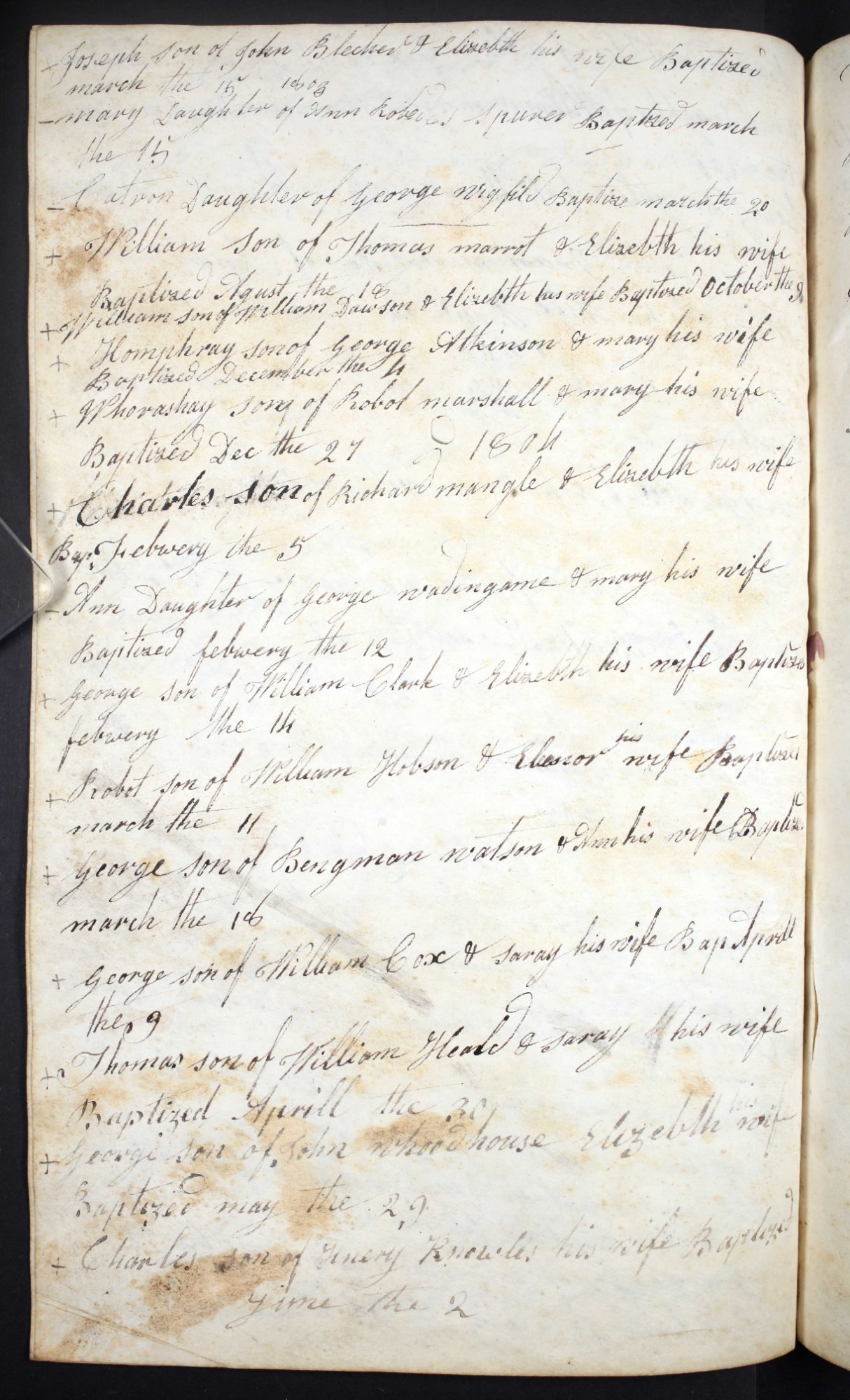
19th century copperplate script - click to enlarge
Transcription (Selected Entries)
Entry 1:
Joseph, son of John Blecher & Elizabeth his wife Baptized march the 15 1803
Entry 2:
Mary Daughter of Ann [unclear] baptised march the 15
Entry 3:
Catron Daughter of George Wigfi[e]ld Baptized march the 20
Entry 4:
+ William Son of Thomas Marrot & Elizabeth his wife Baptized August the 18
Entry 5:
+ William Son of William Dawson & Elizabeth his wife Baptized October the 9
Entry 6:
+ Humphray Son of George Atkinson & Mary his wife Baptized December the [unclear]
Entry 7:
+ [unclear] Son of Robert Marshall & Mary his wife Baptized Dec the 27 [unclear]
Entry 8:
+ Charles Son of Richard Mangle & Elizabeth his wife By, February the 5
Parish registers: Vital records of baptisms, marriages, and burials kept by Church of England parishes.
Handwriting: 19th century copperplate - flowing, cursive style. Much more legible than earlier secretary hand but still requires expertise with period spelling variations.
Format: Short entries following pattern: Name, parents, baptism date. The "+" marks may indicate legitimate birth.
Professional approach: Where a name or date cannot be read with confidence, it is marked [unclear] rather than guessed. This shows professional integrity and allows clients to verify against the original if needed. Entry 2's surname, Entry 7's forename and year, and Entry 6's day are genuinely borderline rather than simply unfamiliar — both would benefit from a closer crop of just that word before being finalised.
Genealogical value: Essential for tracing family trees. These records predate civil registration (which began 1837 in England).
Latin Probate Register Entry — November 1589
Elizabethan probate register · folio 85 · compressed secretary hand
Original Document
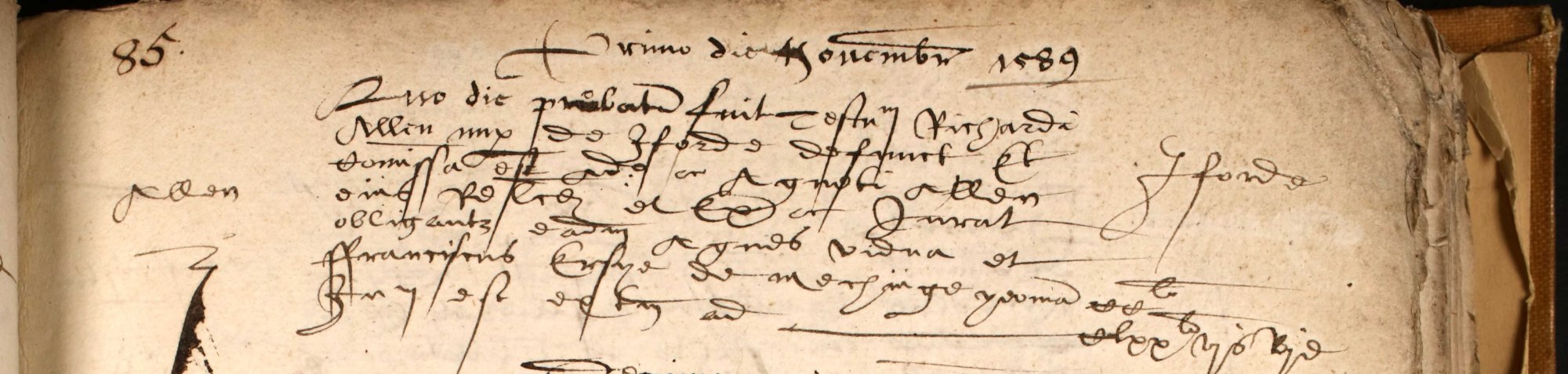
Elizabethan probate register, folio 85, November 1589. Compressed secretary hand with heavy abbreviation — click to enlarge.
Transcription
Probate entry Eodem die probatum fuit Testamentum Richardi
Allen nuper de [unclear] defuncti et
commissa est administratio [unclear] Allen
[unclear] potest de [unclear] et Agnes Allen
obligantis [unclear] et
[Admini]strantibus eadem Agnes viduæ et
iurata est ad sancta Dei evangelia
Translation
Notes on the Document
Script: Compressed Elizabethan secretary hand — one of the most challenging scripts in the palaeographer's repertoire. Every word is heavily abbreviated; letters run together; the same letterform can represent several different letters depending on context. This is a register entry written at speed by a court clerk for a professional readership, not a document intended for lay readers.
Formula: Despite its age and difficulty, the underlying structure is identical to probate clauses found in PCC wills right through to 1733. Probatum fuit Testamentum — Proved was the Testament. The formula was fixed for centuries; only the names change. Recognising the formula is also what makes several words here readable with confidence rather than guesswork: Eodem die ("on the same day") rather than a repeated date, nuper de ("late of") rather than an unrelated phrase, and commissa est ("was committed") rather than the non-word it can look like at first glance — all three are standard turns of phrase in this kind of entry, which is how the letterforms can be checked against what the clerk was very likely writing.
Deceased: Richard Allen, late of [unclear] — the place name is partially obscured. A marginal note on the right, legible only as [unclear] forde, suggests a location containing "ford".
Administrator: Agnes Allen viduæ — Agnes Allen, widow. The feminine viduæ confirms she was Richard's widow taking the oath of administration. Words that cannot be read with confidence are marked [unclear] throughout, and a stretch in the middle of the entry — naming exactly how Agnes was bound into the administration — remains genuinely unresolved rather than filled in with a plausible guess; a higher-resolution image of that section would likely settle it. Square brackets elsewhere indicate expanded abbreviations.
Every Heritage Script transcription of a probate document includes a full translation and explanation of the Latin clauses. For a complete guide to reading PCC probate formulae, see the Heritage Script Journal: What Does the Latin Mean? Reading the Probate Clause on a PCC Will →